


Like many of its smaller Caribbean siblings, Cuba is full of colorful culture and history. It has a great climate and spectacular wildlife both on land and in the water.
Due to its less than friendly relationship with the US, divers often overlook Cuba. The benefit of course is a more authentic holiday, with fewer tourists.
The downside is that trying to organize or research about diving is quite tricky. You can either ask at your hotel and hope they have some information or go on a liveaboard holiday.
May-October are the wettest months, with hurricane season peaking in August and September. The drier and calmer season, December- April, is the best time to dive. In December, the water temperature is a little cooler at 25˚C/77˚F, reaching 30˚C/86˚F by July.
*If you are American, the regulations are changing all the time, especially due to the pandemic. Check this government site for updated rules.
The 17 Best Dive sites in Cuba?
Varadero

Varadero juts out of the Northern coast of Cuba and makes for fascinating features. Its neighboring Varahicacos Ecological Reserve provides calm and clear conditions at reasonable depths.
It has an interesting underwater topography featuring caverns, cenotes, and sloping coral gardens. It even has a few shipwrecks.
What you will see
With over 20 dive sites right off the shore and a short boat ride away, Varadero is great fun. Diving here for a few days means something different every time you jump in the water.
Generally, the shallower sites are close to the peninsula. For example, Las Mandarinas, a beautiful coral reef equipped with fans and whips.
Off to the east, towards Los Cayos (the keys/islets) and Jardines del Rey the waters get deeper. Advanced divers can visit the Caribe and Neptuno wreck. Here you can see giant green morays and tarpons.
Jardines del Rey
The “King’s Gardens” is a stunning archipelago ecosystem made of individual cayos. These include the most popular Cayo Coco, the hub of the region. Cayo Coco has an international airport for stress-free travel.
The archipelago is well known for its white sandy beaches and neighboring coral reefs. It also has the largest flamingo population outside of the US.
Accommodation is generally all-inclusive resorts. Many resorts have a small shop where you can book scuba diving training and tours. You can even book more laid-back snorkeling excursions.
What you will see
From Playa Pilar of Cayo Guillermo to Cayo Paredon Grande, there are approximately 30-40 dive sites. These span along the northern side of the archipelago.
The coral reef is divided into strips, which are 30-45ft/10-15m above the reef. They do however sink deeper and separate along the different channels. In Jardines del Rey there is a variety of soft corals like sponges and grand gorgonians.
Yet, it is the aquarium’s many types of fish that steals the show! Popular sites are Jaula I & II, located by Cayo Jaula, and Las Coloradas & El Triton at the edge of the archipelago.
Jaula I & II
Jaula I and Jaula II are the go-to scuba spots for advanced divers, as the depths averages at 82-115ft/25-35m.
Those with the training to go deeper get to see awesome fish. These include the likes of snappers, groupers, barracudas, nurse sharks, and eagle rays.
Jaula I & II is located between Cayo Coco and Cayo Guillermo, and is accessible depending on where you stay.
Las Coloradas
Las Coloradas, and Triton are spectacular sites to witness Caribbean sea life. This is because they are shallow sites of 40-65ft/12m-20m, and foster many different juveniles.
There is a mild current sweeping through the reef, and it is common practice to do a drift dive. Visibility is 65-100ft/20-30m, and with all the wondrous flora and fauna, it is popular with all divers.
With such diverse underwater wildlife, these sites are a great place to practice your underwater photography skills.
USS Merrimac
Cuba is known worldwide for its decorated history, and being an island, many of its battle scars lie below the surface. Cuba’s warm Caribbean waters are the resting grounds of many war-stricken wrecks. This makes the island a diver’s paradise.
Back in 1898, 8 men cruised the USS Merrimac into the entrance of Santiago de Cuba. Her mission was to be a blockship, but her steering gear was damaged in battle. Fortunately for divers, she still sits in the channel today.
What you will see
The 320ft/98m long wreck sits at 72ft/22m. Her mid-channel position means currents can be strong and diving here is reserved for experienced divers. Those who can dive the site, leave from Punta Gorda, a 5 minutes boat ride away. Due to the constant boat traffic in the harbor, the initial 5m is quite bad, but after that, it clears up to 10-15m/30-50ft visibility.
Since Merrimac’s mission was to be strategically sunk, she was not fitted with any artillery. Yet many of her features, such as propeller, potholes, and anchor are still in great condition. USS Merrimac is one of 4 wrecks of the battle of Santiago de Cuba. Doing all four in a re-trace diving tour is a unique way to steep yourself in maritime history!
Jardines de la Reina
Fitting its royal name, Jardines de la Reina is the gem of Cuban diving. It is the top spot when it comes to their liveaboards. An archipelago stretching 93miles off Cuban’s southern coast, this large marine reserve is in pristine condition, and rich with exquisite sea life.
Fidel Castro was a very keen scuba diver and ocean enthusiast, ensuring strict policies to protect this sanctuary, with commercial fishing and permanent residency prohibited.
Another restriction is the exclusivity of Jardines de la Reina, and only a few hundred recreational divers are permitted here every year, so liveaboards aren’t cheap and fill up fast!
What you will see
The strict regulations have now made Jardines de la Reina and all its islands a wildlife paradise. They support an abundant population of birds, reptiles, caimans and of course sea life!
As many of us know, a good sign of a rich marine environment is its shark population, and Jardines de la Reina is swarming with them!
Up to 6 different species including hammerheads and lemons and even whale sharks can be found here during the fall months.
Book your spot on the next Liveaboard!
Black Coral I & II
Even though shark sightings are pretty much guaranteed in all the dive sites of Jardines de la Reina, the best place to witness this fin-tastic frenzy is at Black Coral I & II.
The top of these sites is 45ft, sloping down to 100ft, and so advanced diver training is required. Also diving experience with sharks is always a good idea, as these sharks are known to be curious of divers, and can get pretty close. Have your camera ready for some cool selfies!
As you meander through channels, you can tick off rays, nurse sharks, parrotfish and schools of jacks from your list of fish to see.
El Farallon
El Farallon, aka “The Cliff” is shallowest at 50ft, sinking to 100ft. This massive seamount is arguably the best spot of the Jardines’ liveaboard itinerary.
This is because its ocean topography is a magnet for pelagics, turtles, sharks, mackerel, large schools of snappers and jacks.
This marine mountain is enormous and can be split into various trips, mostly thanks to its many weaving swim throughs and tunnels, giving you a different perspective every time you dive there.
Bay of Pigs
This quirky named location probably rings a bell from school history classes and learning about the Cold War. The Bay of Pigs was a failed landing operation by Cuban exiles who opposed Fidel Castro’s Cuban Revolution, and a turning point in the American-Cuban relationship.
Dotted around the Bay of Pigs are Playa Larga, Playa Giron, Punta Perdiz, El Juraco Wreck and Cueva de los Peces. Scuba diving isn’t not heavily advertised and so pre booking isn’t an option. Just simply inquire at your hotel and then can help organise a dive guide for you, along with equipment if needed.
What you will see
Diving here is generally split into two options; open water just off the shoreline, or inland through the cenotes and flooded cave systems. The spit of Caya Blancos del Sur protects the Bay of Pigs, keeping the conditions calm. The visibility is a favorable 20-30m/65-100ft and the waters an enjoyable 22-29˚C/71-84˚F in winter/summer.
The main hubs for divers are Playa Larga and Playa Giron, with dive guides touring the local wall dives and the wrecks. For something a little different head inland to the deepest cenote of Cuba; the 230ft/70m Cueva de los Peces.
Playa Larga
At the top of the Bay of Pigs, conditions are the calmest, and hides one of the best diving areas of Cuba for snorkeling and scuba diving. The Bay is a deep trench, so just 165ft-330ft/50-100m from the shore, and the wall plummets down!
What you will see
The diving is a mix of tunnels, slopes, plateaus and canals, decorated with hard and soft corals such as brain coral and gorgonians. At shallower depths, there are plenty of colourful basslets, angelfish and wrasse.
As you go to the deeper sections, you trade color for size, with big barracudas, rays and eels. Purposefully sunken in 1994, the El Jaruco wreck with its local nurse sharks, is a popular dive site.
Cueva de los Peces
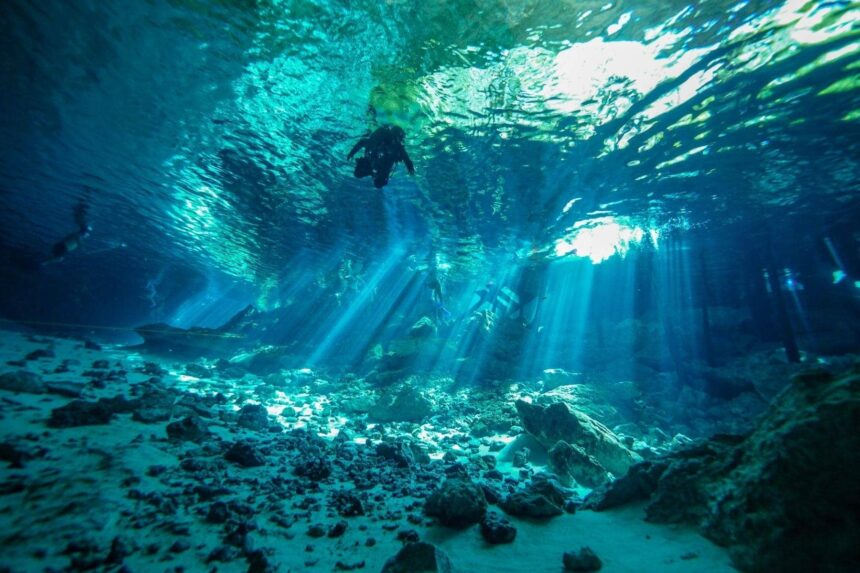
Resulting in long term tectonic activity, Cueva de los Peces is the deepest cenote of Cuba, at 229ft/70m.
This natural pool is just inland of the east coast of the bay, halfway between Playa Larga and Playa Giron. Be warned, just like many beautiful places, it is often overrun with tourists, and you want to get there early to beat the hordes of tourists.
What you will see
Whether you decide to snorkel or scuba dive, you can still enjoy the fresh crystal clear water full of fish.
Although obviously snorkeling is cheaper, scuba diving does mean you get to investigate all the nooks and crannies of the underwater stalagmites and get away from all the other tourists. No more bumping into some stranger on the surface!
Punta Perdiz
The bay’s sometimes rocky coastline can make shore entrances awkward and tricky, as you clamber over uneven ground. However, at Punta Perdiz, the flattened path and convenient step ladder is a welcomed sight.
There is an entrance fee of 15 CUC since it’s a private path belonging to the onsite restaurant, but included is food, drinks and beach equipment.
What you will see
Here the wall is at its most impressive, starting as an easy 10m/33ft plateau it stretches 330ft/100m from the shoreline, and then suddenly drops to 1000ft!
The view is mostly made up of sandy patches with hard corals such as brain coral and staghorn, with common colourful sightings of parrotfish, damselfish, soldierfish, butterflyfish and moray eels.
Isla de la Juventud
Situated on the southwestern side of Cuba, the Island of Youth is tucked away, and mostly sheltered from the prevailing south easterly winds. It is home to Punta Frances Marine Reserve, popular for wall diving, mixed with caves, tunnels, overhangs and even a few wrecks.
The secondest largest marine reserve in Cuba, it is not densely populated. Nueva Gerona is the main hub of the island, and so liveaboards are a top pick for diving here.
Isla de la Juventud is an idyllic adventure destination, with over 50 spectacular dive spots, all within an hour’s boat ride. Here you can also find inland activities like trekking and bird watching.
What you will see
For the wall lovers amongst us, the drop offs around Isla de la Juventud are truly breathtaking. There are constant swim throughs and overhangs to keep you on your toes, adorned with glorious sponges and fans.
The marine life includes the cute reef fish, intricate macro crustaceans, moray eels, and bigger fish such as snappers, jacks, barracudas and the occasional shark.
Popular dive sites are Cueva Azul, Pared de Coral Negro, and the shallower wreck known as Sparta.
See which liveaboard suits you best!
Cueva Azul
A particularly unique dive, Cueva Azul is a near-vertical tunnel, whose base starts at 138ft/42m, and so is reserved for divers with advanced training.
The dive itself is nice and relaxed, slowly rising through crystal blue water, your torchlight bouncing off the glistening glassfish and bigger tarpon.
Have a Little Mermaid moment and channel your inner-Ariel as you gaze up at the sun poking through the top of the cave complex
Pared de Coral Negro
Translated as “Black Coral Wall”, it’s not hard to guess the calling card of this dive site. Generally black coral grows on slopes of a minimum of 160 feet, and so is not a common sight for recreational divers.
However here it starts at 100-115ft/30-35m, and so with a deep diving speciality and a good torch, divers can enjoy this intricate coral and the delicate macro species usually found living on them; think skeleton shrimps, spider crabs and seahorses.
Jibacoa/Sparta Shipwrecks
If you’re still new to diving and yet to get your deep diver training, there are still sights to be seen at the shallower depths. The most memorable is the shipwreck Sparta, an old military ship lying on her side at 30ft/10m.
At this depth you have plenty of time and light to investigate her well conserved hull, still with her guns, anchor and ladders. You can penetrate inside as well, but remember to only enter if you have proper training as you can damage your gear and the coral.
Love Wreck diving? See which ones made into our Top 5 List!
Maria la Gorda
You’re probably seeing a theme here with the wall dives as there is another wall dive here around Maria la Gorda. However, unlike the steep drop offs of the Bay of Pigs, Maria’s underwater topography slowly slopes in stepped sections.
This is better suited to those who might be a little intimidated by steep vertical walls, and no matter how much experience you have, seeing an ocean floor will help level out your buoyancy.
What you will see
Encompassing the bay of Maria la Gorda is the Great National Park Guanahacabibes, declared a UNESCO Natural Biosphere Reserve.
Legend has it that Maria la Gorda (Fat Mary) was the host of a Pirate bar, and is said to be buried with treasure. Although yet to be found, perhaps metaphorically the treasure is the kaleidoscope of corals, with its reef fish glistening like golden doubloons!
There’s also a sunken 18th century ship and plenty of swim throughs and caverns to explore to add to the glamour of the area.
Read our guide on how to control your buoyancy!




 Take a moment to look at this.


We plan to go to the Iberostar Ezmeralda at Cayo Cruz. Anyone know if there is any dive shop nearby or scuba dive site nearby?
Thank you