

















































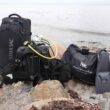

 STAHLSAC Dry Bag
Stahlsac Drylite: Packs Flat, Stays Dry
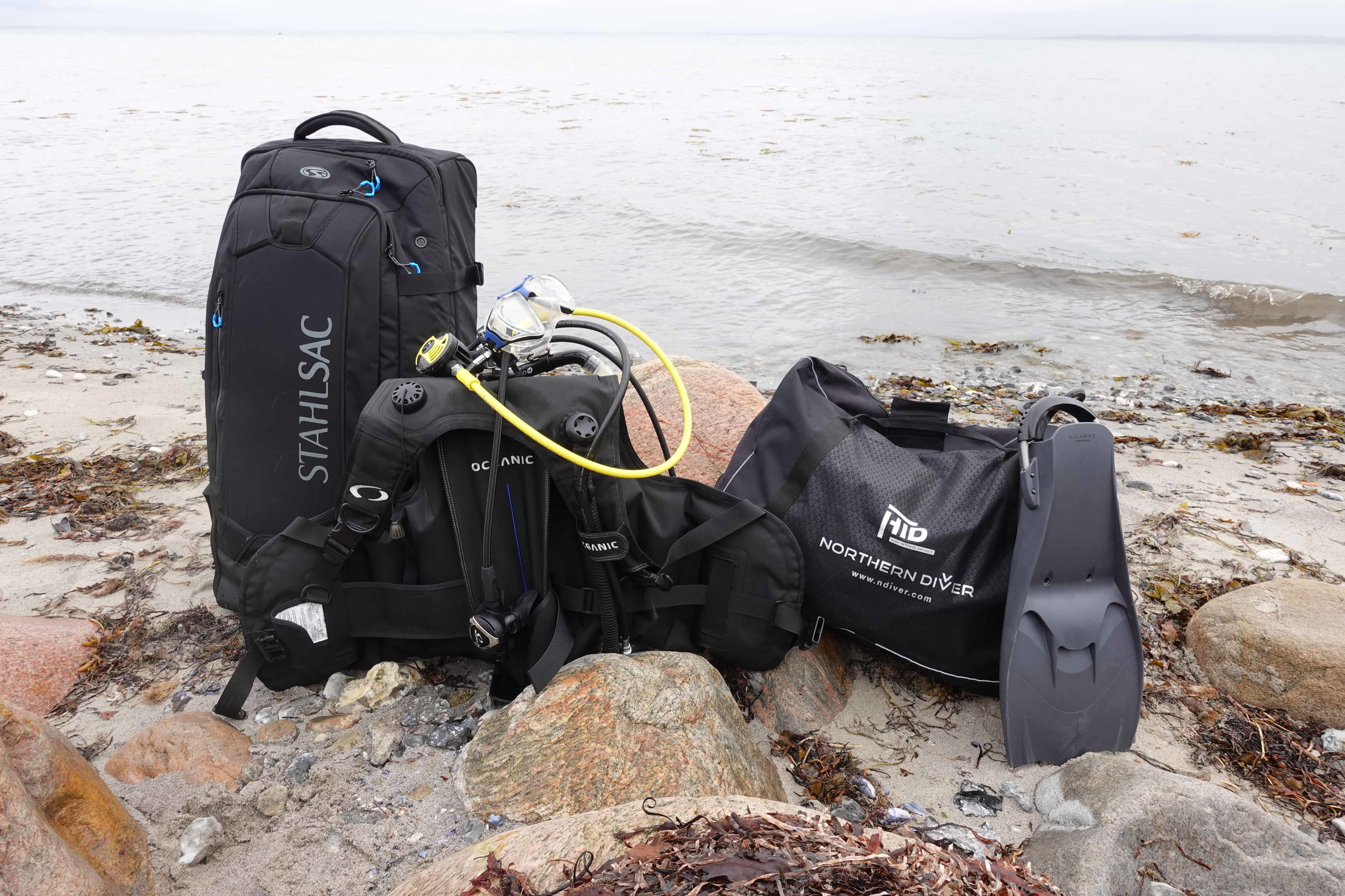
Most dry bags are bulky even empty. The Drylite folds down to almost nothing, then welded seams keep your kit bone-dry through rain, kayaking, and dive boats. Tough nylon shrugs off scrapes, and the 18 and 25 liter sizes carry like a backpack. Toss it in and forget it.
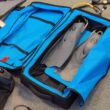
 CRESSI Dive Bag
Cressi Moby 7: The 115L Bag That Holds Everything
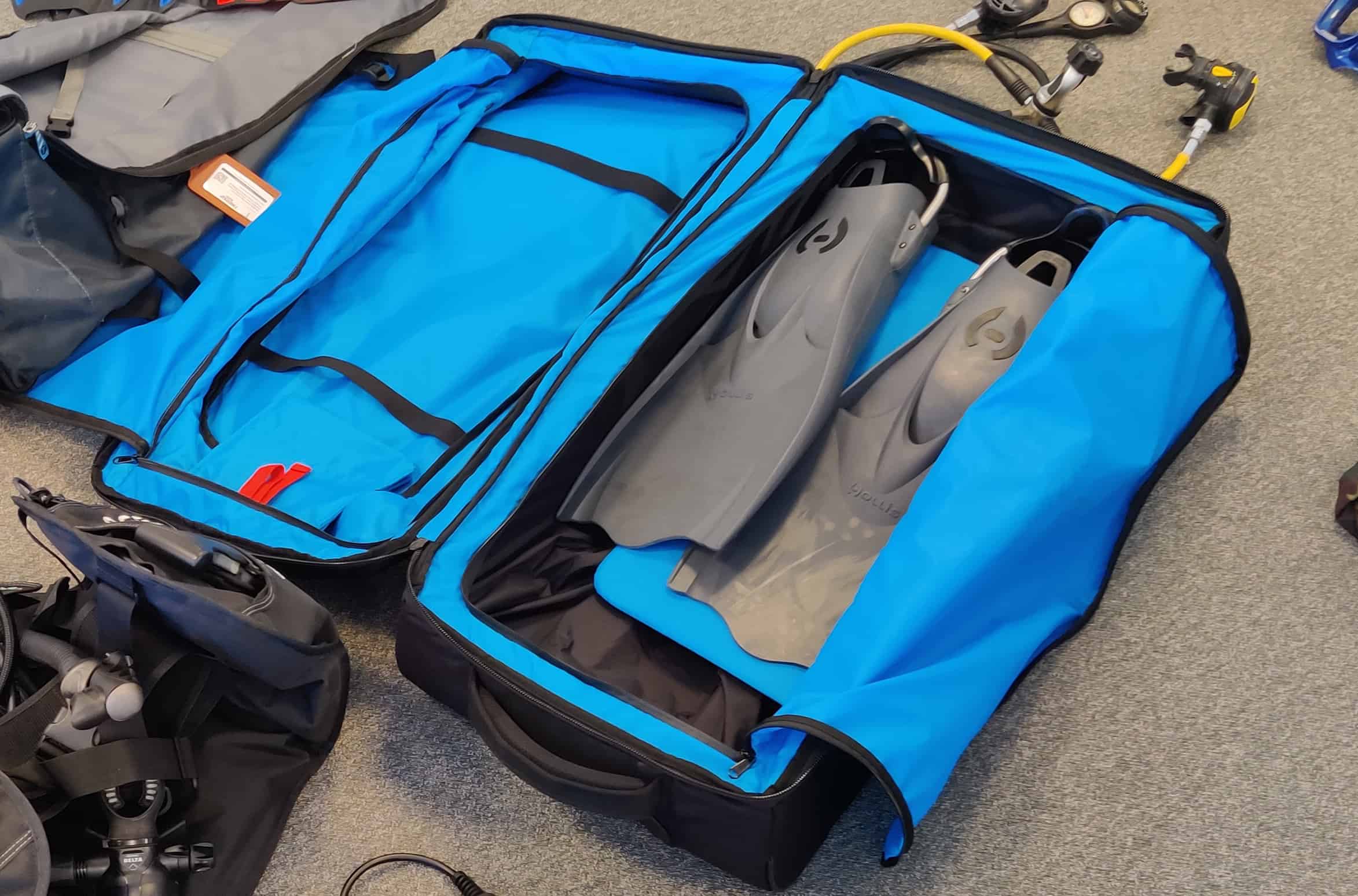
Dive gear is heavy, awkward, and hard on cheap zippers, so the Moby 7 went big: 115 liters that swallow a full cold-water kit with room to spare. The reinforced wheels survive baggage handlers who clearly hate you, and it stays light when empty. Pack once, roll through, dive happy.
 See here
Win Free Scuba Gear
We test new gear weekly and give most of it away to newsletter subscribers.
🤿 Join our newsletter to learn how you can get your hands on some free scuba gear!
New giveaways every month!

Time to upgrade your dive computer?
We've tested every dive computer worth buying in 2026: Garmin, Shearwater, Suunto, Apple Watch Ultra, etc.
See the top picks before you upgrade or buy a new dive computer
 EXPLORE
Browse 400+ gear reviews
BCDs, regulators, dive computers, masks — every piece tested in the water by working dive instructors. No paid placements.

10 wreck dives every diver should do
From WWII warships to ghost liners — the most spectacular wrecks on the planet, with dive plans and operators for each.


The best dive bags need to handle frequent travel, rough handling, and constant exposure to saltwater, sand, and sun, and not all models are built for that level of use. Differences in materials, wheel systems, storage layout, and durability can have a major impact when you are moving between airports, boats, and dive sites.
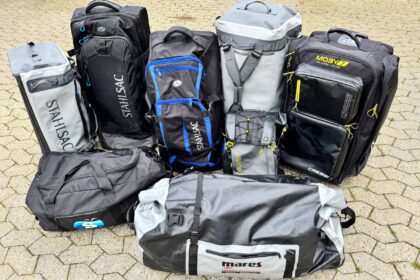
Over the past three years, the DIVEIN team has tested more than a dozen dive bags on real dive trips across Southeast Asia, the Caribbean, and the Red Sea. We packed them to capacity, rolled them through airports, loaded them onto boat decks, and rinsed them after sandy shore dives to evaluate long-term durability and usability. Based on this hands-on testing, we selected the best dive bags for 2026, organized by travel style and type of diving, so you can find the right option for your gear.
Stahlsac Steel Rolling Bag 34 Inch


Stahlsac Steel Rolling Bag 34 Inch Rolling Bag review
The Stahlsac 34 inch Steel Wheeled Bag is the largest one in our dive bag guide, and although expensive, we don’t consider it overpriced. This 34-inch/148L bag is part of Stahlsac’s Steel collection, which features well-made bags offering great, diver-specific features and separate compartments for wet and dry clothing or gear.
It has strong and sturdy wheels and handles, which makes traveling through airports and dive boats much more comfortable.
Cressi Moby 7


Where to buy
We compare prices daily across all major online stores.
See all 3 pricesCressi Moby 7 Scuba and Dive Bag review
The Cressi Moby 7 is a large, wheeled dive bag designed for divers who travel with a lot of gear. Offering a generous 115-liter capacity, reinforced construction, fin pockets, and practical features like a telescopic handle and convertible backpack straps, it’s an excellent choice for serious divers who need space and flexibility. Just be cautious of the weight if you pack it to the brim.
Scuba.com Big Duffel Bag


Scuba.com Big Duffel Bag Scuba and Dive Bag review
The Scuba.com 90L Big Duffel Bag delivers practical dive gear storage at an accessible price point. Built from durable water-resistant polyester with thoughtful features like drain ports and a YKK waterproof front pocket, it’s perfect for recreational divers who want a no-nonsense solution for transporting their gear.
The 90L capacity easily accommodates a full set of diving equipment. While it may not have the premium materials of higher-end options, the reliable construction and smart design touches make the Big Duffel Bag a solid choice for divers who prioritize function over flash.
Cressi Venom


Where to buy
We compare prices daily across all major online stores.
See all 3 pricesCressi Venom Dry Bag review
When it comes to keeping your dive gear dry and organized, the Cressi Venom Dry Backpack proves that you don’t need to compromise between waterproof protection and everyday comfort. This 30-liter roll-top bag combines the reliability of a dry bag with the practicality and comfort of a traditional backpack.
It is an ideal companion for divers or watersports lovers who need to transport their gear and everyday essentials with peace of mind. The Venom also features two external pockets so values are protected from splashes and sprays.
Stahlsac Abyss Duffel


Where to buy
We compare prices daily across all major online stores.
See all 4 pricesStahlsac Abyss Duffel Dry Bag review
If you’re a diver, a seafarer, or just a casual wet-and-wild wanderer, you need a strong bag that keeps up with your crazy adventures! The latest duffel bag range, Abyss from Stahlsac, is made from durable and weatherproof materials and is a serious contender for any serious traveler.
Although marketed as a diving duffel bag, we found that the robustness of these travel bags makes them suitable for any kind of rugged adventure. Like many water sport duffel bags, this Abyss collection can be carried as a traditional holdall or as a backpack.
And also has a few extra handles that other brands don’t, for even more carrying options. Another key difference from other duffel bags we have tested is the ultra-durable nylon and firm reinforced base, which makes it extra reliable.
Stahlsac Curacao Clipper


Where to buy
We compare prices daily across all major online stores.
See all 4 pricesStahlsac Curacao Clipper Scuba and Dive Bag review
The Stahlsac Curacao Clipper weighs just 8.8 lbs, has a capacity of 96 liters, and has a robust frame at its foundation. A little different from its bigger brother, the 34 Inch Steel Wheeled Bag, the Curacao Clipper is predominantly one large compartment, good for a full set. The top compartment is good for weeks worth of clothes.
These two spacious compartments keep wet and dry gear separate. The telescopic handle and the thick wheels makes it easy to manoeuvre and its hard plastic base means it won’t topple over. The Stahlsac Curacao Clipper is a wise investment for international divers.
Aqualung Explorer II

Where to buy
Track this priceAqualung Explorer II Scuba and Dive Bag review
Built to last with rugged 1680D polyester, the 123-liter Aqualung Explorer II roller bag is well-suited for all your dive-travel needs. And, at only 9.5 lbs. (4.4 kg), this capacious bag isn’t too heavy for long-haul travel, either.
The bag is easy to transport through airports with rugged wheels and a telescoping aluminum handle, as well as a top handle for lifting it on and off luggage carousels and the like. The internal frame structure should stand up to rough handling by baggage carriers, too.
On the outside of the bag, you’ll find two convenient fin pockets, an exterior pocket for odds and ends, and corrosion-resistant zippers. Inside the bag, you’ve got 123 liters of space to work with, pockets for organization, and compression straps to keep all your gear snug.
ScubaPro Sport Mesh 'N Roll 100

Where to buy
We compare prices daily across all major online stores.
See all 3 pricesScubaPro Sport Mesh 'N Roll 100 Scuba and Dive Bag review
The ideal companion for a day boat trip, the ScubaPro Sport Mesh ‘N Roll 1oo dive bag makes it easy to get your gear to and from the dive site.
With heavy-duty nylon construction, a top handle, wheels, and two carrying straps, you can either roll it down the dock, carry it, or pop it onto your back using the two handles as back straps.
Mesh sides save weight on the bag, plus make it easy for damp gear to dry after a dive. Although the main compartment is missing pockets, there is plenty of room for all your gear with a capacity of 100l. There are also handy top internal and side external zippered pockets for smaller items.


How We Test: Dive Bags
Why trust us
At DIVEIN.com we know that a dive bag is more than luggage—it protects thousands of dollars of life-support gear. Our review team loads every bag with a full kit—BCD, regulator set, fins, mask, wetsuit or drysuit—and puts it through the same punishment it will face in the real world.
We wheel bags through airports, haul them across sandy beaches, and soak them in rinse tanks to check drainage and odor control. We examine seams, zippers, and hardware after repeated saltwater exposure and heavy handling.
Comfort and usability are just as important. We evaluate how easy it is to organize gear, how comfortable backpack straps or handles feel when fully loaded, and how smoothly rollers glide over rough pavement.
Finally, we weigh price against performance to judge value. Some budget-friendly mesh bags are perfect for occasional divers, while premium rollers justify their cost for frequent flyers who need airline-ready toughness.
We share both the strengths and the weaknesses we find, so you can choose the bag that matches your diving lifestyle and budget with confidence.

Dive Bags Buyer’s Guide
A great dive bag is more than just luggage—it’s the mobile home for all your life-support gear. From airports to liveaboards and from sandy beaches to rocky shores, your bag has to protect expensive equipment while making transport easy.
The DIVEIN.com team has spent years hauling gear around the world, testing dive bags in every scenario to help you choose the right one. Below, we break down the key considerations when it’s time to buy a dive bag of your own.
Types of Dive Bags
Dive bags fall into a handful of main categories, each designed for different needs. Roller bags—also called wheeled or trolley bags—are the top choice for travelers. Their sturdy frames, telescoping handles, and smooth wheels turn airport marathons into easy strolls, even when loaded with a full set of scuba gear.
Duffel bags, sometimes with backpack straps, are lighter and flexible. They work well for car trips or dive boats where you need space but not a rigid frame. Many are simple one-compartment designs, though some offer split compartments to separate wet and dry items.
Mesh bags or day bags are the grab-and-go solution for local diving or day trips. The mesh lets water drain and gear dry on the ride home, and they’re easy to rinse after use. If you’re hiking to a remote shore entry or climbing ladders with both hands full, a backpack-style bag offers hands-free comfort and better weight distribution.
And finally, for underwater photographers or technical divers carrying fragile gear, hard cases—rigid boxes often lined with foam—give the ultimate protection from impact or crushing, though they are heavier and less flexible for general travel.

Choosing the Right Dive Bag for Your Style
Match the bag to the kind of diving you actually do. For international travel and liveaboards, a large wheeled roller with reinforced corners and a sturdy base is worth the investment. It can swallow a full set of gear and handle airport baggage abuse.
If you mainly dive locally by car or small boat, or if you typically dive with a local shop and just need a means to carry your gear for the day, a mesh duffel or backpack is ideal: it drains water, dries quickly, and is easy to rinse after the dive.
Divers who regularly hike to remote shore sites will appreciate a backpack-style bag with padded straps and good weight distribution.
And if you’re carrying delicate electronics or camera housings, nothing beats a rigid hard case or a soft bag with removable padded inserts to shield against impact.

Understanding Construction and Materials
The life of a dive bag is tough: saltwater, UV rays, sand, and rough baggage handling. That’s why the fabric matters. Most high-end bags are made from nylon or polyester with a high denier rating—a measure of fiber thickness. A higher denier (for example 600D or 1000D) means thicker, more abrasion-resistant fabric, while lower denier fabrics are lighter and more flexible but can wear faster.
You’ll also see tarpaulin or PVC-coated fabrics, which are waterproof and extremely rugged, making them ideal for wet environments. Some bags combine heavy-duty base panels with lighter sidewalls to balance weight and durability.
Corrosion-resistant zippers and hardware are essential; saltwater will quickly destroy ordinary metal pulls or cheap wheels. Reinforced seams and double-stitching keep heavy loads from tearing. In short: high denier equals toughness, but you want a smart mix of strength and weight for easy handling.

What to Look For
Start with capacity and size. Your bag must hold a full set of gear—BCD, regulator, fins, mask, wetsuit or drysuit—plus extras if you travel. Too small and you’ll be cramming gear; too large and you risk overweight baggage fees or a bulky bag that’s hard to carry.
Consider water management. Dive gear is often wet or damp—a bag that traps moisture can cause mildew and odor. Look for drainage ports, mesh panels, or separate wet/dry compartments to keep things fresher.
Organization saves time and protects delicate items. Multiple compartments, fin sleeves, and padded regulator pockets mean you won’t dig through a mountain of gear to find your mask or camera.
Consider the design. Some bags also feature a split design, allowing you to either pack two full sets of dive gear, or pack clothes on one side and gear on the other, usually in a waterproof compartment.
Comfort is critical. Whether you’re rolling through airports or hiking down a rocky trail, choose wheels and a telescoping handle or padded backpack straps to suit your routine. Remember the trade-offs: the more protection and rigidity you want, the heavier the bag becomes.
Bigger capacity is convenient but can trigger overweight airline fees and be awkward to store. Lightweight and packable designs are easier to travel with but may sacrifice padding and reinforcement. And while highly waterproof materials protect against rain and spray, they can also trap moisture inside if you pack wet gear.

Final Thoughts & Checklist
Before you buy a dive bag, run through this simple checklist:
- Does it fit your full dive kit and clothes if traveling?
- Does it allow wet gear to drain/dry without soaking your dry items?
- Is it durable against salt, UV rays, and the rigors of airline travel?
- Can you carry it comfortably (wheels, straps, handles)?
- Are there enough compartments/pockets to keep organized?
- Is the shape suitable for your fins and other gear?
- Do you expect to fly frequently? Does it meet common airline size/weight constraints?
- Is the cost justified by what you need?
A dependable dive bag makes every trip easier and protects the gear that keeps you safe underwater. With the right mix of durability, smart design, and carrying comfort, your bag will earn its place as one of the most important pieces of your dive kit.
Dive bags FAQs
For a full scuba kit, most divers need a bag in the 90–120 liter range. This size comfortably fits fins, BCD, regulator, wetsuit, mask, and accessories without overstuffing. If you travel with bulky cold-water gear or large fins, aim closer to 120 liters. For warm-water travel with compact gear, a smaller 70–90 liter bag may be enough.
Some scuba gear can go in carry-on, but not everything. Regulators, dive computers, masks, and cameras are commonly packed in carry-on to protect fragile and expensive items. Fins, BCDs, and wetsuits usually need to be checked due to size. Always check airline size rules and battery restrictions, especially for dive lights.
Roller dive bags have wheels and a rigid or semi-rigid structure, making them easier to transport through airports and ideal for heavier loads. Duffel-style dive bags are lighter, simpler, and often easier to pack into tight spaces on boats or in cars. Rollers are best for frequent flyers, while duffels are better for weight savings and flexibility.
An empty dive bag should ideally weigh between 5 and 10 lbs (2.3–4.5 kg). Lightweight bags help you stay within airline weight limits, especially since scuba gear adds up quickly. Heavier roller bags offer durability but can reduce how much gear you can pack before hitting baggage limits.
A fully waterproof dive bag is not always necessary, but water-resistant materials are highly recommended. Most divers use standard travel dive bags for transport and a separate dry bag for wet gear or boat use. Waterproof bags are useful if you expect heavy exposure to water, but they are often heavier and less breathable.
Pack heavier items like fins along the sides to create structure and protect softer gear inside. Place regulators and delicate equipment in padded sections or carry-on bags. Use your wetsuit or clothing as cushioning around fragile items. Remove or secure hoses and buckles to prevent stress during transit, and avoid overpacking to reduce pressure on your gear.
 Take a moment to look at this.


Looking for a bag that can be checked with wheels. To fit BCD, Fins, Mask, Wet suit. Regulator
There’s a few good options in the Guide.