


The title for the most awesome part of the world might belong to California. Inland, the state boasts numerous lush national parks like Yosemite, with its sky-high sequoias, or the beautifully barren Death Valley. But drive along its coastline and you can really soak in its salty beauty, as you pass countless pristine beaches and sharp cliff faces. And just beyond the shoreline, California’s beauty continues below the blue.
Diving in California is arguably the best in the States; maybe second to Florida depending on who you ask! Among other images, the iconic kelp forests are easily identifiable, but there are wrecks and plenty of marine life too.
The majority of the diving can be done offshore, so accessibility is easy enough, but tide changes are big and so are the surges that come with them. We recommend diving with a local school/guide as they’ll have the perfect intel on the when and the where–the essential conditions for picking sites.
Diving in California
The majority of the dive sites in California are near Monterey Bay and San Diego county off the southern coastline. Wreck Alley is an especially great area, with 8 sites, a great playground for history lovers. Off the coast of SoCal are a few clusters of islands such as Channel and Farallon Islands, great 1-3 day trips.
Click on these keywords to help you find what you’re looking for!
13 Unbelievable Dive Sites: The Best Scuba Diving in California – 2026 Update
Southeast Farallon & Maintop Island
The diving scene of California begins at the Farallon Islands, nearly 30 straight miles west of San Francisco’s Golden Gate Bridge. The Farallon Islands are a marine sanctuary, home to over 300,000 nesting birds and a mating site for seals and sea lions.
What you will see:
Any habitat that supports a healthy population of seals or sea lions almost always has a hungry population of sharks lurking nearby. Cage diving is extremely popular around Southeast Farallon and Maintop Island. It can be very hectic since the great white sharks only visit from approximately September to November, so book in advance! There is no chum involved and rubber decoys are used to attract the sharks. All operators have an easily accessible surface cage, available for certified and non-certified divers. Others offer submersible cages going to 30-50 ft/10-16m, offering the chance of a more personal encounter since the sharks are more comfortable in mid-water depths.
Middle Farallon & Noonday Rock
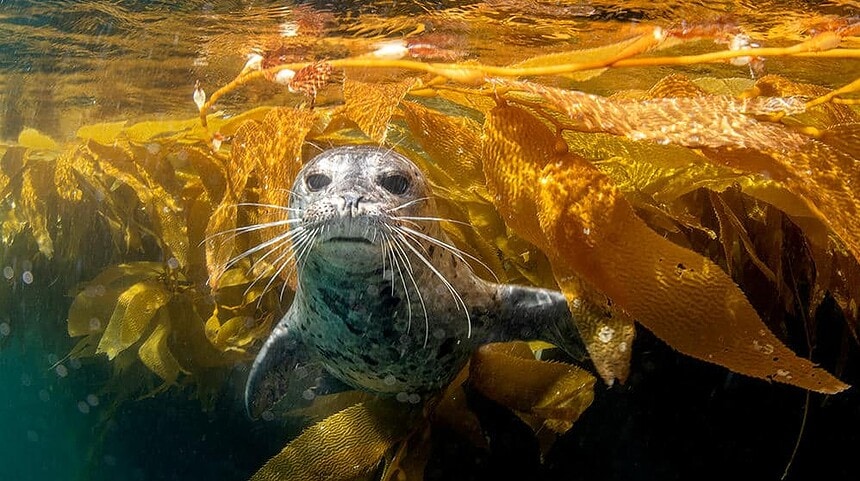
Most of the waters around the Farallon Islands are protected and so diving is only permitted around Middle Farallon and Noonday Rock. Since shark season happens in the fall, recreational diving happens in the spring and summertime.
What you will see:
The underwater seascape is made up of pinnacles with steep slopes, walls and canyons. Carpeting these rocky outcrops are colorful sponges and sea anemones. Fish life consists of rockfish, scorpionfish and the impressive wolf eels. Intermediate to advanced deep diving experience and nitrox certification is definitely required due to its deeper waters (tec diver deep at some spots) and testy conditions.
AROUND MONTEREY BAY
Monterey Bay is home to the world-famous aquarium, and so it is no surprise that world-class diving is just on its doorstep. Just a few yards offshore is Monterey Bay Canyon, a uniquely peculiar geographical feature. This canyon upwells deep deep water (600-6000 ft/200-2000 m deep!) full of nutrients and plankton. Which in turn supports larger marine life, allowing us to see whales, dolphins, seals and adorable otters just off the boulevard!
Breakwater Cove
Breakwater Cove is protected by both the natural harbor and the marina just south of the entrance. This makes conditions generally very calm and so it can be a little crowded with the training of new divers. Depths are from 10-60ft/3-18m and very accessible for all.
What you will see:
Being a site so close to land and many people, wildlife sightings tend to be on the smaller end of the spectrum. But there are plenty of eye-catching corals, nudibranchs, and macro life to keep the photographers happy! Due to its convenient off-shore location, it is popular at night, with reports of chunky lobsters! During fall and winter, Californian sea lions tend to hang out at the end of the pier, so maybe they will join underwater too!
Lover’s Point
Both just off Perkins Park, Lover’s Point and Otter’s Cove are to the south and north respectively of the same beach. There are concrete steps East of Lover’s Point taking you straight in. Great for beginners of shore diving or those still getting the hang of their drysuits!
What you will see:
Underwater is a very green scene, full of seagrass and kelp, so be careful not to tangle your fins. Thanks to the abundance of vegetation, visibility is great, with perch and the great Californian sheephead. Like Breakwater Cove, Lover’s Point is a great spot for some night diving. Although marine life is a little less spectacular on this site, Lover’s point is an easy-peasy dive for those of you who just want to relax and cruise through the kelp.
Otter’s Cove
Access to this site is either from the stairs in the middle of Perkin’s Park or the parking area by Ocean View Boulevard and Beach street intersection. As you agonizingly pull on your 7mm wetsuit, be sure to look up at the incredible view and the dolphins and whales that tend to swim by.
What you will see:
Over to the west, the topography changes to a more rocky scene of scattered boulders, with giant and bull kelp flourishing, making it feel wilder than Lover’s Point. Fishing is permitted here so marine life isn’t as abundant as other sites. But otters and seals/sea lions are a common sighting, as they dance through the kelp and maybe even playfully nip at your fins.
Whaler’s Cove
Whaler’s Cove and Bluefish Cove (see below) are one of the main highlights of diving on the west coast. Both within Point Lobos Reserve, they are rich with sea life and incredible marine topography. Due to their protected status, there is a limit of 15 pairs of divers per day and you must acquire a permit before diving here.
What you will see:
Just off the Boat ramp, where divers enter the water, there is a mix of scattered rocks and kelp. Staying in the bay and just north promises easier and calmer conditions, up to 60ft/18m. Coming north out the bay, there is a sandy trench, lined with a dominant wall to your east and gentler to your west. Once beyond here, depths increase (up to 100ft/30m). Living amongst the boulders are wolf eels, octopi and crustaceans. Maybe even a leopard shark will cruise by you in clear kelpy waters.
Bluefish Cove
Bluefish Cove is reached by coming from Whaler’s Cove, so many choose to kayak over to avoid a lengthy surface swim unless you have an underwater scooter. Then descend onto a wondrous wall, starting at 40ft/12m. The wall gently slopes down, continuing beyond 100ft/30m.
What you will see:
Due to fishing/hunting being prohibited in the reserve, there is plenty of life, both invertebrates and vertebrates. Like much of the West Coast, eccentric nudibranchs and soft corals decorate your view. Common sightings include rockfish and the local cabezon (scorpionfish like). Surface conditions can get choppy, so intermediate diving experience is expected.
North Monastery Beach
If you think a shore entry is the easy option, North Monastery is going to change your mind. On a calm, flat day it is easy enough. But when the weather picks up, the surf packs a punch, and it’s potentially dangerous if you don’t know what you’re doing. Experienced locals dub their special technique the “monastery crawl”! On your knees. Remember the diving philosophy, Do It Right! Once in, the rewards are high, with many voting this their favorite West Coast site. The beach lies on the Eastern rim of the Carmel Canyon so a 200-yard surface swim can get you in 200/60m ft of water!
What will you see:
This deep canyon causes upwelling of nutrients and cold water, promising much wildlife and great visibility! Typical of this area, kelp is abundant on-site. The topography is generally a wall with an endless bottom, so keep an eye on your depth gauge! You can spot leopard sharks, lobsters, rockfish and plenty of macro life here as well. Mammals like seals and dolphins aren’t uncommon, so beware of a great white bully lurking nearby.
AROUND SAN DIEGO
Continue southwards along the breathtakingly beautiful California coastline, and the next scuba diving hub after Monterey Bay is San Diego. San Diego is fascinating due to the incredibly deep canyons just offshore, encouraging cold nutrient-rich waters up to the surface, supporting kelp forests and their inhabitants.
Wreck Alley
A unique highlight of the San Diego area is the abundance of wrecks locally. This is because for decades the US Navy has been deliberately sinking old ships off in the shallows. There are now eight wrecks, varying in depths and difficulty. The most popular of them are HMCS Yukon and Ruby E (see below)
HMCS Yukon
The newest addition to its underwater family, the HMCS Yukon is definitely the most exciting one as well. Only sunk back in 2000, this 366ft/111m vessel sitting at 100ft/30m is still in very good condition. Due to some unfavorable weather conditions prior to her sinking, HMCS Yukon lies on her port side.
What will you see:
In just twenty years, HMCS Yukon is encrusted with all kinds of coral and surrounded by schools of fish that call it home. It was a crew-carrying ship and so lacked the enormous cargo holds typical of many other wrecks. This makes internal navigating extremely tricky due to tight corridors and mazes of stairwells. If you wish to go inside you must first be properly trained and with an experienced guide. Visibility can be a reasonable 50ft, allowing you to enjoy grand views of its form, propellers and gun turrets. Its intact condition and plentiful marine life make it a great model for photography! Although rare (within diving depths) in Southern California, Metridium anemones are common on HMCS Yukon. The external part of the wreck is accessible for intermediate divers, but penetration is reserved for those more advanced divers, experience with wrecks or even tec.
Ruby E
A veteran to Wreck Alley, Ruby E was the second vessel added to the area in 1989. She started her life in the 1930s as a rumrunner catcher, intercepting ships during prohibition years. After prohibition, she transported and processed fish from South America. However ironically when she was commissioned to her watery grave, she didn’t sink as easily as planned. This was due to hidden sealed compartments that were added to her when she was smuggling drugs during the South America years!
What will you see:
Ruby E is conveniently sitting upright, with depths ranging from 50-85ft/15-25m. Penetrating and navigating is comparatively easier than Yukon due to cargo holds being left open, perfect for those completing their wreck specialty. Heading deeper into her structure should be left for the more experienced. After 30 years underwater she has started to crumble and there are many sharp edges to watch out for. The outside promises vibrant views of soft corals and anemones and many fish and nudibranchs. Remember to bring a torch so you can peek in through portholes or spot large sheep crabs residing in the surrounding sand. Ruby E has a little bit of something for everyone, and is a firm favorite in the wreck diving community!
NOSC Tower
For those of you who have ever dived under a jetty, you can attest that marine life loves vertical structures! Although similar in look to an oil rig, the NOSC Tower was in fact an oceanic research center. The supporting legs had always been an interesting dive site, but it was in 1988 that a storm knocked over the topside platform, converting it to a wreck site. Now, beautifully reincarnated, it supports the very marine life it had been built to study.
What you will see:
Submerged at 70ft/21m, the tower is nearly completely carpeted in mussels, providing a great food source for ochre sea stars, which can grow to a few feet across! Deeper sections are replaced with colorful anemones and the pure white Metridiums, swaying like a 1970s shag carpet. The tower is a top spot to practice your photography! For macro-lovers, tiny crabs and shrimps hide in all the nooks and crannies. A wide-angle is great for capturing the sun breaking through the structure, or the angel shark lurking on the bottom. This site is easily divable for all levels and a good place to work on your buoyancy as you weave in and out of the frame.
La Jolla Bay
La Jolla and its local dive sites are a great place to experience quintessential California diving. A highlight of these sites is that for the most part parking is easy and cheap, access is via a ramp or steps and there are washrooms nearby. Under the water, there are two massive canyons-La Jolla Canyon and Scripps Canyon-meeting just offshore from the bay area, supplying plenty of spots for all types of divers!
La Jolla Cove
La Jolla Cove, at the southern end of the bay La Jolla Bay, is definitely one of the top spots in the area when it comes to training new divers due to its easy sandy beach entry and docile conditions. It is also great for bringing the family for a relaxing snorkeling session.
What will you see:
The initial part of La Jolla Cove is a rocky reef, just at 10-20ft/3-6m deep. Here there is plenty of life, including the garibaldi, the Californian goldfish, moray eels and cute horn sharks. Continuing north, away from the beach, you arrive at the magnificent kelp forest. Here it is common to encounter playful seals and sea lions. And at just 40ft/12m, all levels can enjoy this awesome dive.
The Main Wall/Vallecitos Point
For those of you who like a bit more thrill and depth in their dive, check out the canyon itself. The North Wall, Scripps Pier, Scripps Canyon and La Jolla Canyon are all sites dotted along the submarine trenches that meet in the bay. Vallecitos Point, or aptly called Main Wall, is the probably the most popular of this set.
What you will see:
Start by surface swimming for approximately 5-10 minutes due west from the beach. Once descended, this puts them in 30ft/10m of water, and near the edge of the canyon wall. Head west a little while more and arrive at the wall of La Jolla Canyon. Around the wall there are large fish like sheephead, halibut and rockfish. The wall itself is stepped, the first level being 45 ft/13m-200ft /60m. After that it rapidly drops to over 700ft/215m, so keep an eye on your computer! Along the wall are undercuts and caves, and so a torch is useful for seeking out burrow dwelling creatures, such as lobsters or smaller gobies.
OFF THE COAST
One of the great appeals of diving is being on day trips. Many liveaboards and boat trips operate off the coast of Los Angeles, traveling to the Channel Islands archipelago. The top three–diving wise–are Santa Cruz, Catalina Island and San Clemente. All are within a few hours, so you can relax in the salty sea air, and catch a sunset snooze on the way back.
Santa Cruz
The Channel Islands National Park and its marine sanctuary consists of Santa Cruz and its 4 neighbours. Santa Cruz is the largest of all 8 islands and is considered the best for diving. Santa Cruz is famous for rocky walls with overhangs and caves. The Painted Cave is one the biggest caves in the world, and its entrance is accessible from the surface, with boats often taking their guests inside.
Santa Cruz Island – Channel Islands
What will you see:
Depending on the conditions of the day and certification of the divers, there are varying wall depths to suit everyone. Santa Cruz is perhaps lacking in fish numbers but certainly does not lack color. Spread along the wall are green anemones, bushy red gorgonians, orange sponges, yellow nudibranchs and enormous pink sea stars. There is also the Peacock Wreck for the history buffs. She sits upright in calm conditions at 60-80ft/18-25m, ideal for those wanting to advance or get their wreck spec.
Catalina Island
Just two hours from Los Angeles, all kinds of water lovers come to Catalina Island. Apart from diving, you can snorkel and kayak in the shallows, keeping everyone in the family happy!
What will you see:
Catalina Island is a diverse diving destination, offering the wrecks, walls, kelp forests and caves. Popular sites include Casino Point, Farnsworth Banks, SueJac wreck and Blue Cavern Point. Farnsworth Banks on the western side is famous for the rare Purple Hydrocoral. The topography is made of several sea mounts starting at 60ft/18m, with good visibility of 30-100ft/10-30m. Fish life includes the colorful garibaldi, the omniours black sea bass and seals dancing in the kelp. Currents can pick up, and diving around Catalina Island has conditions for experienced divers as well as beginner/intermediate level.
San Clemente
Sante Clemente is the most Southern of the Channel Island Archipelago, 60 miles from the mainland. It is about a 6-8hours boat ride from San Diego, so multi day trips are normal. It has been a US Navy base since 1934, so if you’re lucky you might see a cool Top Gun style fly by! But it also means recreational diving is limited to when military training isn’t taking place.
What you will see:
The top spots are mostly located at the ends of islands, and are weather dependent. Pyramid Head and Cove at the southeastern tip have a lot to offer and usually have the best conditions as it is protected from the prevailing wind. Depths range from 20-100ft/6-30m with great visibility of 70ft/20m. Topography starts as rocky pinnacles and boulders, slowly becoming thick kelp forest in the middle depths. Marine life varies with sheephead, moray eels, lobsters, leopard sharks and seal lions among them. If you do find any strange artifacts, please leave them for the military to collect!
California has a lot to offer when it comes to diving, and the best bit is that a lot of it is right on the Eureka state’s doorstep. Shore diving is very popular in this region, so divers tend to have all their own gear and organize their own trips.
There is a truly American and friendly vibe in the Big Sur diving community, with everyone sharing their personal tips. This warm welcome is mirrored underwater, through the curiosity of Californian sea lions and inquisitive otters. And like many before, become bewitched by the ethereal kelp and all its residents.
If you have traveled and dived California, let us know which of the above dive sites was your absolute favorite.
Frequently Asked Questions about the Best Diving in California | 13+ Top Dive Sites
There are a lot of extraordinary places to dive in California.<br><br>These are some of our favorites: 1. Middle Farallon & Noonday Rock<br>2. Lover’s Point<br>3. Otter’s Cove<br>4. Whaler’s Cove<br>5. Bluefish Cove Take a look at all <a href=”https://www.divein.com/diving/diving-in-california/” rel=”follow” data-wpel-link=”internal”>13 sites to Dive in California</a>.
These are some of the best dive sites for beginners in California: 1. Southeast Farallon & Maintop Island<br>2. Breakwater Cove<br>3. Lover’s Point<br>4. Otter’s Cove<br>5. North Monastery Beach See more great dive sites in our <a href=”https://www.divein.com/diving/diving-in-california/” rel=”follow” data-wpel-link=”internal”>California Dive Guide</a>.
 Take a moment to look at this.

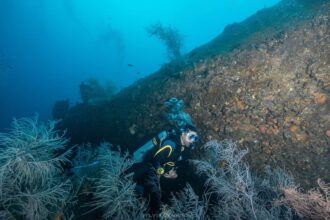


Autumn diving in Cali rocks. Depending on where you go, some dive spots will host the migration of larger fish. Check out the dive spots. If you’re going through a dive shop they’ll have the appropriate wetsuits. Otherwise, check out our guide for an idea of the thickness needed.
Looking to make a dream come true for my hubby bday. He wants to scuba dive around oct 1-9. Can he dive in cali in october?