DIVEINDIVEIN
  • Scuba Gear Reviews
    Editor's Pick15+ Best Dive Computers in 2026Read review →
    Masks17 Best Dive Masks
    BCDs21 Best Scuba BCDs
    Fins25 Best Scuba Fins
    See all scuba gear reviews
    Dive Computers
    • Best Dive Computers
    • Best Beginner Dive Computers
    • Best Air-Integrated Dive Computers
    • Best Smartwatch Dive Computers
    Masks
    • Best Dive Masks
    • Best Snorkel Masks
    • Best Prescription Dive Masks
    • Best Prescription Snorkel Masks
    • Best Full Face Dive Masks
    • Best Full Face Snorkel Masks
    BCDs & Wings
    • Best Scuba BCDs
    • Best Backplate & Wings
    Fins
    • Best Scuba Fins
    • Best Freediving Fins
    Wetsuits
    • Best Wetsuits
    • Best Women's Wetsuits
    • Best Kids Wetsuits
    Dive Watches
    • Best Dive Watches
    • Best Seiko Dive Watches
    Underwater Cameras
    • Best Underwater Cameras
    • Best Waterproof Cameras
    • Best Action Cameras
    • Best Underwater Phone Housings
    • Underwater Cameras & Housings Buying Guide
    Dive Lights
    • Best Dive Lights
    • How to Choose a Dive Light
    Bags
    • Best Dive Bags
    • Best Dry Bags
    Regulators
    Drysuits
    Scuba Tanks
    Underwater Scooters
    Dive Boots
    Dive Knives
    Spearguns
    Metal Detectors
    Reef-Safe Sunscreens
  • Liveaboards
    Indian Ocean · Most popular10 Best Liveaboards in the MaldivesRead review →
    South America · Ecuador10 Best Liveaboards in the Galapagos
    Red Sea · Egypt10 Best Liveaboards in Egypt
    South-East Asia10 Best Liveaboards in the Philippines
    See all liveaboard guides
    CaribbeanReefs, wrecks, blue water
    • Bahamas
    • Belize
    Central AmericaCenotes & big-fish action
    • Costa Rica
    • Mexico
    South AmericaGalápagos & beyond
    • Galapagos Islands
    Red Sea & Middle EastCoral walls & wrecks
    • Egypt
    Indian OceanManta & whale sharks
    • Maldives
    South-East AsiaCoral triangle macro
    • Indonesia
    • Thailand
    • Similan Islands
    • Philippines
    • Myanmar
    PacificSharks & remote atolls
    • Australia
    • Fiji
    • Micronesia & Palau
    Plan Your TripTips · Operators · Resorts
    • All Liveaboards
    • Aggressor Fleet
    • Best Dive Resorts
    • Travel Tips & Tricks
  • Snorkeling Gear
    • Snorkeling Gear
    • Best Snorkeling Sets
    • Best Snorkels
    • Best Snorkel Masks
    • Best Full Face Snorkel Masks
    • Best Snorkel Fins
    • Difference Between Scuba and Snorkeling Fins?
  • Dive Destinations
    South-East Asia · 50 sitesBest Diving in IndonesiaRead review →
    South America · Bucket listBest Diving in the Galapagos
    Red Sea · IconicBest Diving in Egypt
    Indian OceanBest Diving in the Maldives
    Most popular destinations
    CaribbeanReefs, wrecks, blue water
    • Antigua & Barbuda
    • Aruba
    • Bahamas
    • Barbados
    • Bonaire
    • British Virgin Islands
    • Cayman Islands
    • Cuba
    • Curacao
    • Dominica
    • Dominican Republic
    • Grenada
    • Guadeloupe
    • Jamaica
    • Martinique
    • Puerto Rico
    • St. Lucia
    • St. Maarten & Saba
    • Tobago
    • Turks & Caicos
    Mexico
    • Mexico
    • Cozumel
    Central AmericaCenotes & big-fish action
    • Bay Islands
    • Belize
    • Costa Rica
    • Panama
    South AmericaGalápagos & beyond
    • Colombia
    • Galapagos Islands
    United States
    • California
    • Florida
    • Hawaii
    • North Carolina
    Europe & Mediterranean
    • Denmark
    • Mallorca
    • Malta
    • Turkey
    Red Sea & Middle EastCoral walls & wrecks
    • Egypt
    Indian OceanManta & whale sharks
    • Maldives
    AsiaCoral triangle macro
    • Indonesia
    • Bali
    • Gili Islands
    • Komodo
    • Raja Ampat
    • Sulawesi
    • Cambodia
    • Japan
    • Philippines
    • Thailand
    • Vietnam
    South PacificSharks & remote atolls
    • Australia
    • Fiji
    • Palau
    • Solomon Islands
    Plan Your TripThemed picks · Tips
    • All Destinations
    • Best of the Caribbean
    • World's Best Wreck Diving
    • Travel Tips & Tricks
  • Articles
    Recent ArticlesView all
    Infinity Bay Resort for Groups: Dive Trips, Family Reunions, & Everything In Between
    SunBreeze Hotel: Easy Reef Diving in the Heart of San Pedro
    Passport to Paradise: The Stress-Free Way to Dive North Sulawesi with Murex & Lembeh Resort
    Infinity Bay Spa & Beach Resort: West Bay Ease & Reef-Front Diving
    Ibagari Boutique Hotel: Intimate Luxury Meets Roatan’s Reef
    Dive Science Demystified: Gasses, Partial Pressure And Air For Diving
    Utila Lodge Resort & Marina: Where Relaxation Meets the Reef
    Where to Snorkel in Egypt: 5 Top Snorkel Spots
    Dive, Dine and Discover – A Culture & Cuisine Expedition through Raja Ampat with Tait Miller
    Golden Rock Resort: A Botanical Escape For Underwater Explorers
    Wave Goodbye to Underwater Hand Signals and Say Hello to Garmin’s SubWave Tech
    BVI Wreck Week 2025: Unveiling the Treasures of the Deep
    Featured Articles
    Featured
    Anthony’s Key: Sustainable & Stylish Dive Resort
    Featured
    Margaritaville Beach Resort: Subtle Sophistication at Ambergris Caye
    Featured
    Barefoot Cay Resort: A Private Paradise on Roatan’s South Shore
    Featured
    Choosing the Right Shearwater Dive Computer
    Browse Categories
    Scuba95Dive Travel11Scuba Gear8
  • Join our cool newsletter
  • About DIVEIN
  • Contact DIVEIN
Find Us on Socials
Reading: 15 Best Dive Sites in Guadeloupe in 2026
DIVEINDIVEIN
  • Gear
  • Liveaboards
  • Destinations
  • Cameras
  • Snorkeling
  • Travel
  • Best Scuba Diving
  • Home
  • Dive Computers
  • BCDs
  • Regulators
  • Masks
  • Fins
  • Wetsuits
  • Egypt
  • Maldives
  • Galapagos
  • Philippines
  • Thailand
  • Bahamas
  • Egypt
  • Galapagos
  • Costa Rica
  • Cozumel
  • Bay Islands
  • St. Maarten & Saba
  • Action Cameras
  • Waterproof Cameras
  • Snorkels
  • Snorkel Sets
  • Snorkel Masks
  • Snorkel Fins
  • Full Face Snorkel Masks
Search
  • Scuba Gear Reviews
  • Liveaboards
    All Liveaboards
      • Bahamas
      • Belize
      • Costa Rica
      • Mexico
      • Galapagos Islands
      • Egypt
      • Maldives
      • Indonesia
      • Thailand
      • Similan Islands
      • Philippines
      • Myanmar
      • Australia
      • Fiji
      • Micronesia & Palau
      • All Liveaboards
      • Aggressor Fleet
      • Best Dive Resorts
      • Travel Tips & Tricks
  • Snorkeling Gear
    • Snorkeling Gear
    • Best Snorkeling Sets
    • Best Snorkels
    • Best Snorkel Masks
    • Best Full Face Snorkel Masks
    • Best Snorkel Fins
    • Difference Between Scuba and Snorkeling Fins?
  • Dive Destinations
    All Dive Destinations
      • Antigua & Barbuda
      • Aruba
      • Bahamas
      • Barbados
      • Bonaire
      • British Virgin Islands
      • Cayman Islands
      • Cuba
      • Curacao
      • Dominica
      • Dominican Republic
      • Grenada
      • Guadeloupe
      • Jamaica
      • Martinique
      • Puerto Rico
      • St. Lucia
      • St. Maarten & Saba
      • Tobago
      • Turks & Caicos
      • Mexico
      • Cozumel
      • Bay Islands
      • Belize
      • Costa Rica
      • Panama
      • Colombia
      • Galapagos Islands
      • California
      • Florida
      • Hawaii
      • North Carolina
      • Denmark
      • Mallorca
      • Malta
      • Turkey
      • Egypt
      • Maldives
      • Indonesia
      • Bali
      • Gili Islands
      • Komodo
      • Raja Ampat
      • Sulawesi
      • Cambodia
      • Japan
      • Philippines
      • Thailand
      • Vietnam
      • Australia
      • Fiji
      • Palau
      • Solomon Islands
      • All Destinations
      • Best of the Caribbean
      • World's Best Wreck Diving
      • Travel Tips & Tricks
  • Articles
    All Articles
    Browse categories
    • Scuba95
    • Dive Travel11
    • Scuba Gear8
    • Anthony’s Key: Sustainable & Stylish Dive ResortFeatured
    • Margaritaville Beach Resort: Subtle Sophistication at Ambergris CayeFeatured
Follow US
Home » World's best scuba diving » 15 Best Dive Sites in Guadeloupe in 2026
Travel

15 Best Dive Sites in Guadeloupe in 2026

Last updated: July 19, 2023
Published: March 20, 2020
By
Katt Andryskova
Share
Rocky headland and offshore sea stacks meeting bright turquoise Caribbean water in Guadeloupe
Guadeloupe's sites are split between exposed coast like this and the calmer leeward side, so the day's dive plan depends as much on the wind as on your certification.
Three scuba divers silhouetted at the mouth of a dark underwater cave in Guadeloupe
La Grotte aux Barracudas trades colour for atmosphere. Without a torch everything inside the overhang goes flat blue, which is exactly why the silhouettes work so well here.
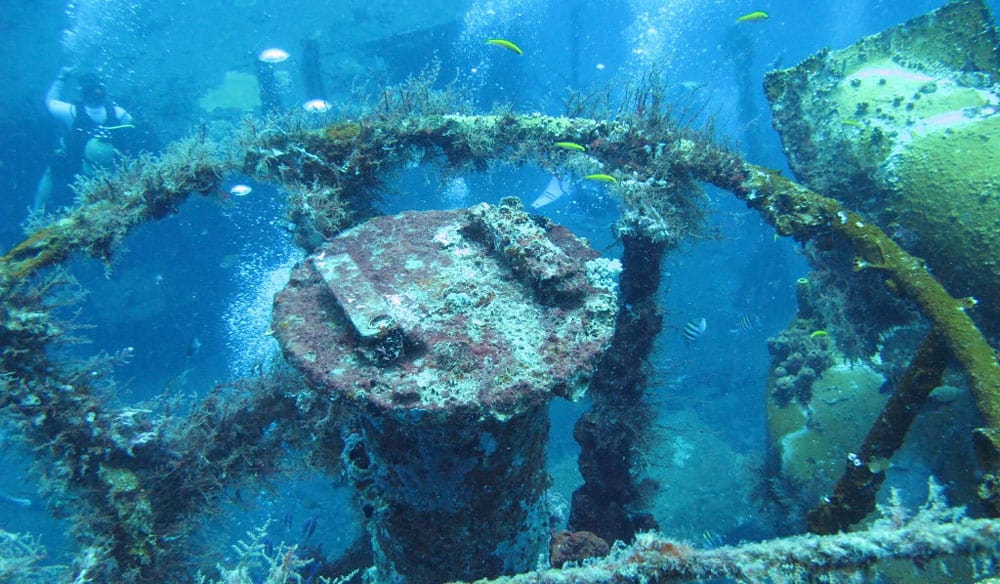
Coral-encrusted wreck structure of the Augustine Fresnel with divers exploring in the background
Daylight reaches every corner of this wreck, so it reads as an approachable first wreck rather than a deep technical one. The growth on the frame does most of the visual work.
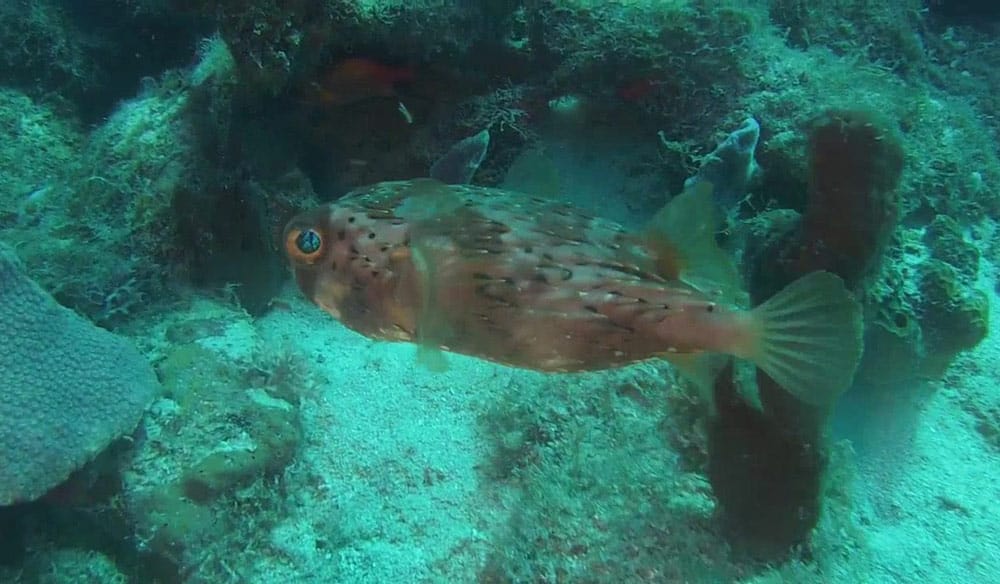
Spotted porcupinefish hovering beside coral heads and sponges on a reef in Guadeloupe
Point Lezarde rewards divers who slow down. Porcupinefish like this one tuck into the ledges and hold position as long as you keep a respectful distance instead of chasing the shot.
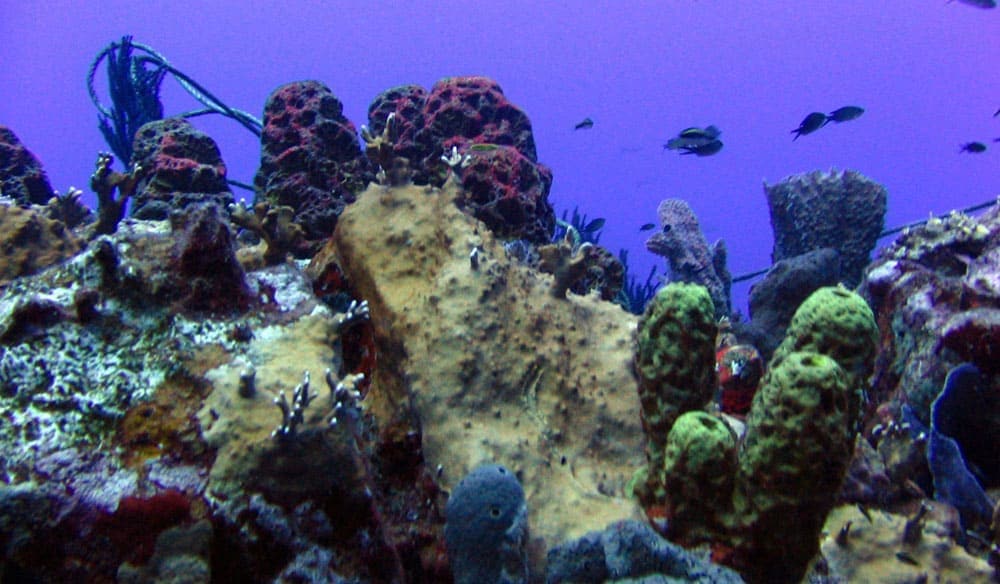
Red, green and yellow sponges covering a reef ridge with fish in the deep blue water beyond at Sec Pate
Offshore sites like Sec Pate carry the loudest sponge colour in Guadeloupe, and the drop into blue behind the ridge is where the bigger fish turn up.
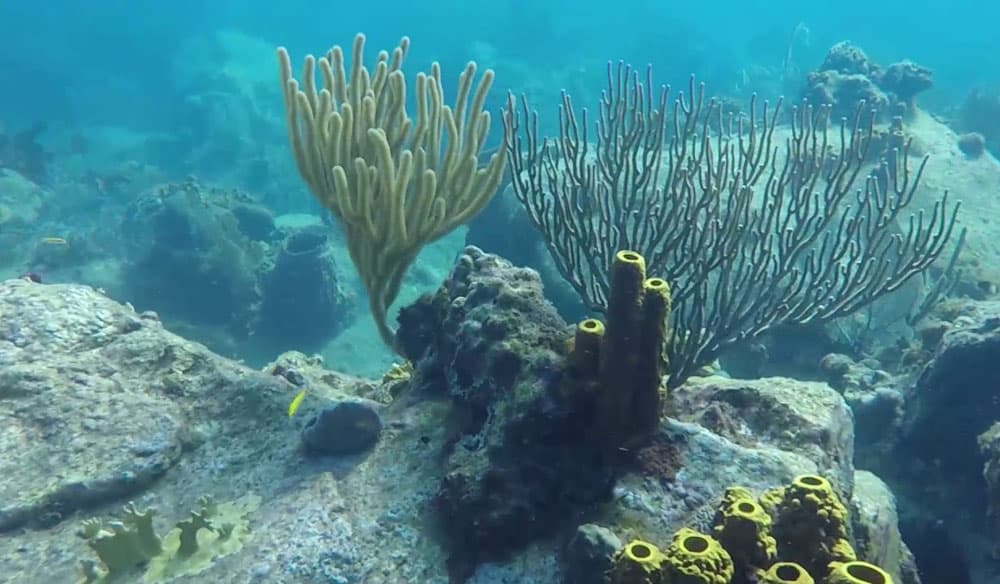
Sea plumes and yellow tube sponges growing over a rocky reef south of Bouillante, Guadeloupe
Shallow, bright and low relief, this stretch is more about sponge and gorgonian colour than dramatic topography. Easy diving with plenty to photograph.
Shipwreck hull crusted with sponges and surrounded by a dense school of silvery fish in Guadeloupe
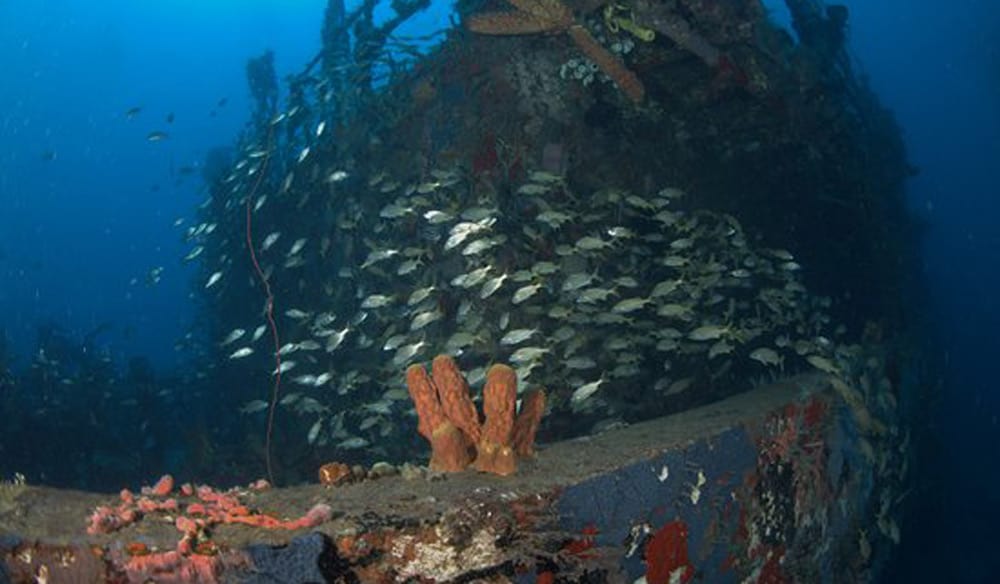
The school stacks up tight against the hull because the wreck breaks the current, which is why structure like this out-fishes the open reef around it.
Lionfish beside wreck beams thick with orange cup coral and sponges at the Gustavia site in Guadeloupe
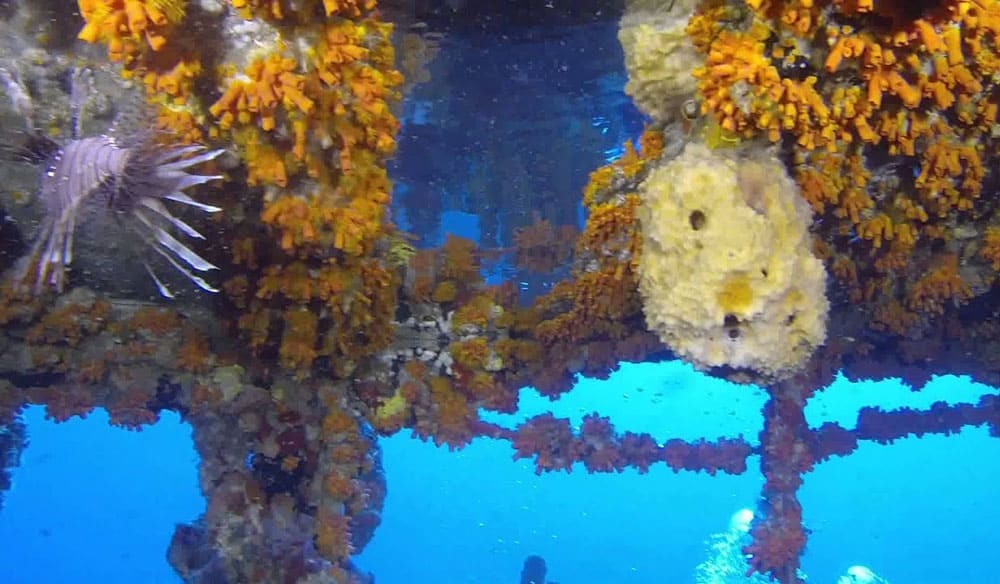
All that orange cup coral says the wreck has been down long enough to count as reef. The lionfish is the less welcome part of that, an invasive species that thrives on structure.
Mangrove islets in shallow turquoise water under a heavy storm sky at Grand Cul-de-Sac Marin, Guadeloupe
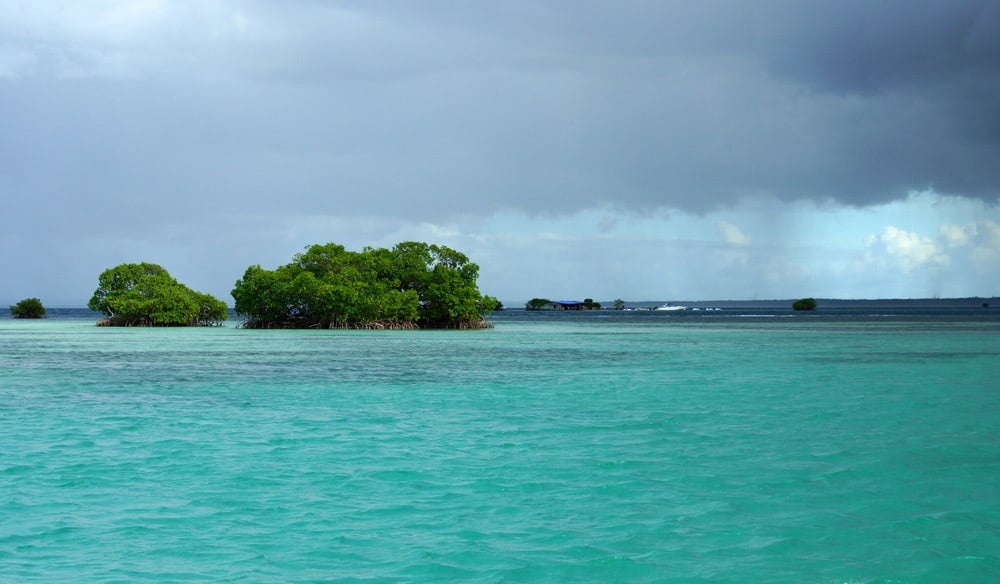
This is nursery water, not deep reef. Shallow mangrove roots and juvenile fish are the draw, and visibility drops fast once weather like this rolls through.
Yellow tube sponges and sea rods covering a reef mound in clear blue water at Jardin Japonais, Guadeloupe
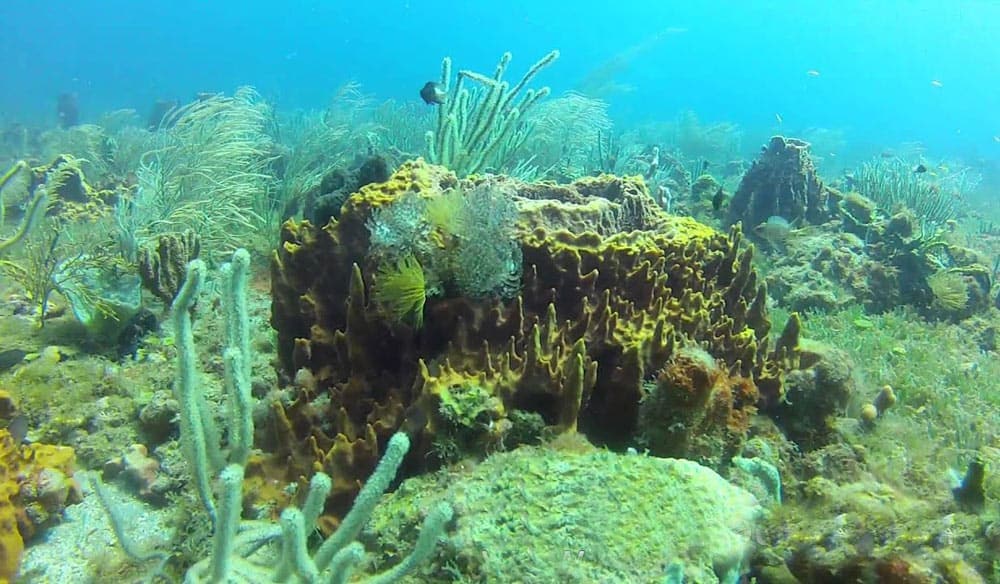
Sponge and soft coral cover like this is what earns the garden name. Slow, shallow and camera friendly rather than a big-animal dive.
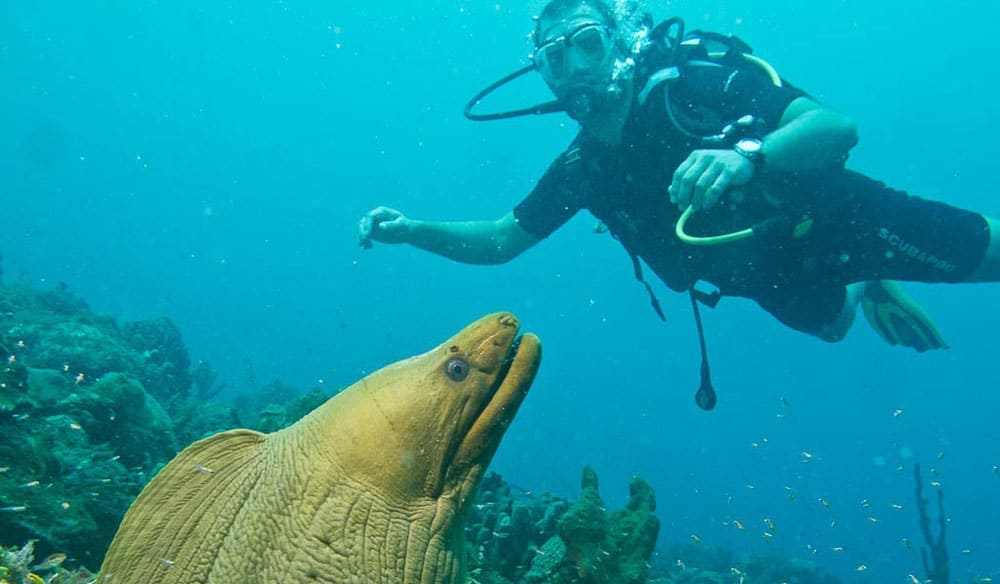
Green moray eel rearing up from the reef with a scuba diver hovering behind it at The Aquarium, Guadeloupe
Morays this size are half the reason the site earns its name. Keep your hands in and the eel stays curious rather than defensive.
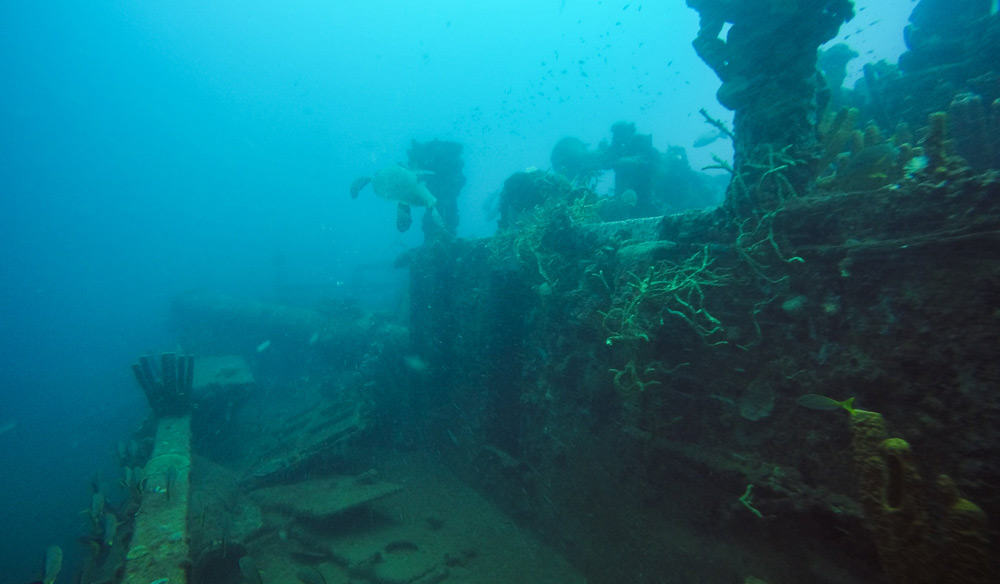
Diver swimming along the encrusted deck rail of the Franjack wreck in Guadeloupe
The Franjack sits upright with its rails already thick with growth, so most of the interest is on the outside of the hull rather than inside it.
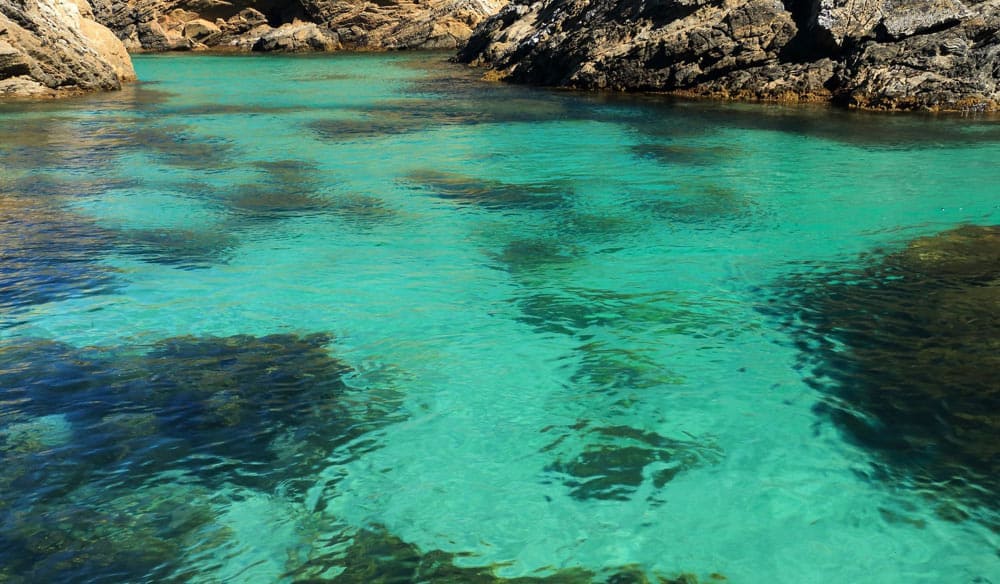
Shallow turquoise water over rock and seagrass patches in a sheltered rocky cove at La Piscine, Guadeloupe
The name fits. It is calm, shallow and clear enough to read the bottom from the surface, which makes it a soft landing for first dives and snorkelers.
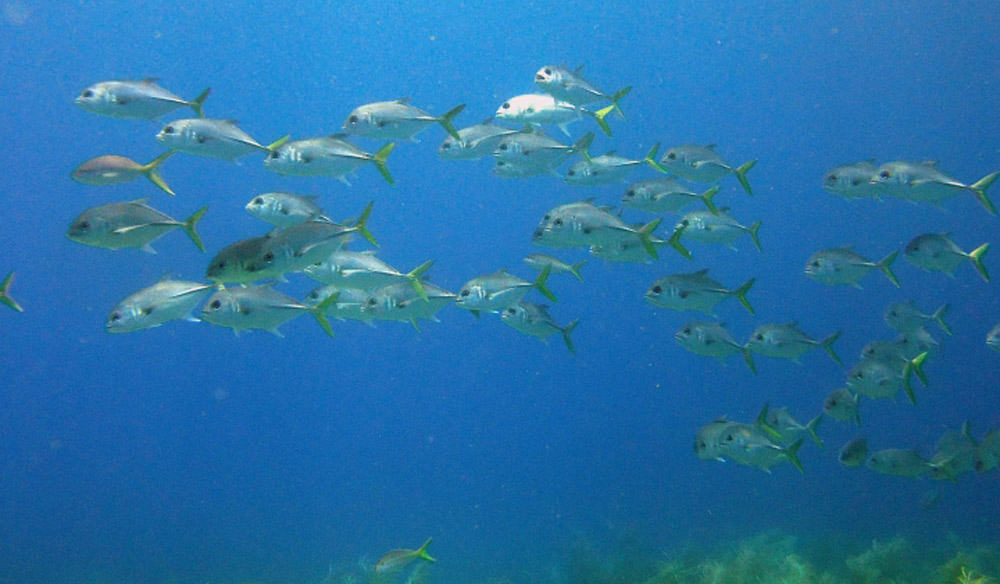
School of horse-eye jacks cruising through open blue water above a patch of reef
The action at Pointe Carrangue happens off the reef, not on it. Keep glancing out into the blue, because that is where the schools form up and pass by.
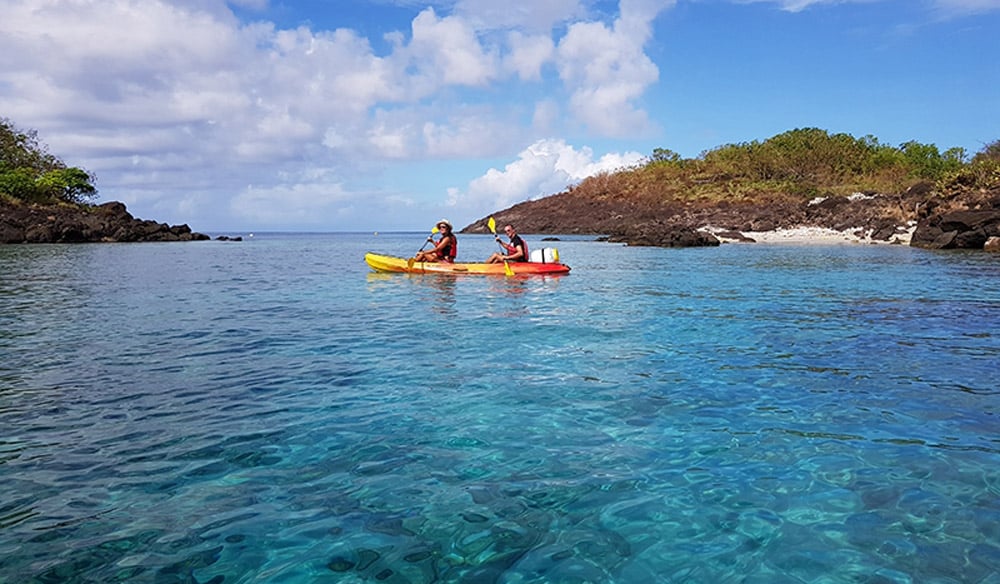
Two kayakers paddling across clear turquoise water beside a rocky green headland at Point Malendure
Water this transparent from the surface is a fair preview of what waits below. The sheltered bay also makes an easy paddle for anyone burning off a surface interval.
Rocky volcanic shoreline with palms and green hills above calm blue water in Guadeloupe
Volcanic rock drops straight into the water along this stretch, no long sandy wade first. That steep edge is what puts depth within a short swim of the shoreline.
List of Images 1/16
Rocky headland and offshore sea stacks meeting bright turquoise Caribbean water in Guadeloupe
Three scuba divers silhouetted at the mouth of a dark underwater cave in Guadeloupe
Coral-encrusted wreck structure of the Augustine Fresnel with divers exploring in the background
Spotted porcupinefish hovering beside coral heads and sponges on a reef in Guadeloupe
Red, green and yellow sponges covering a reef ridge with fish in the deep blue water beyond at Sec Pate
Sea plumes and yellow tube sponges growing over a rocky reef south of Bouillante, Guadeloupe
Shipwreck hull crusted with sponges and surrounded by a dense school of silvery fish in Guadeloupe
Lionfish beside wreck beams thick with orange cup coral and sponges at the Gustavia site in Guadeloupe
Mangrove islets in shallow turquoise water under a heavy storm sky at Grand Cul-de-Sac Marin, Guadeloupe
Yellow tube sponges and sea rods covering a reef mound in clear blue water at Jardin Japonais, Guadeloupe
Green moray eel rearing up from the reef with a scuba diver hovering behind it at The Aquarium, Guadeloupe
Diver swimming along the encrusted deck rail of the Franjack wreck in Guadeloupe
Shallow turquoise water over rock and seagrass patches in a sheltered rocky cove at La Piscine, Guadeloupe
School of horse-eye jacks cruising through open blue water above a patch of reef
Two kayakers paddling across clear turquoise water beside a rocky green headland at Point Malendure
Rocky volcanic shoreline with palms and green hills above calm blue water in Guadeloupe
SHARE

The Guadeloupe islands are comprised of five main islands and offer visitors a fantastic blend of the tropics, African, South Asian and French culture.

Each of the five islands have a unique atmosphere and stunning landscape.

Quick note: When you go, make sure to split your time up between the islands.

The country has over 150 miles of pristine coastline. The whole archipelago is comprised of over a dozen small islands surrounded by warm twinkling water and stunning jungles covering the mountains. Travellers flock to this island nation to get away from the stress of city life and to experience the beauty of the Caribbean Sea.

One of the main reasons to travel to these isolated and wild islands of Guadeloupe is to scuba dive. Jacques Cousteau himself considered the dive spots around pigeon island to be one of the best in the world. The dive sites around the archipelago vary greatly in diversity, and diver levels. You will be able to find dive sites suitable for open water, or more advanced levels.

A divers note: Keep in mind that French is the national language of this island nation and finding a dive guide who speaks English may be a little challenging. So, when you are booking your dive trip, enquire about the languages they offer.

The 15 Best Dive Sites in Guadeloupe Islands?

La Grotte Aux Baracudas
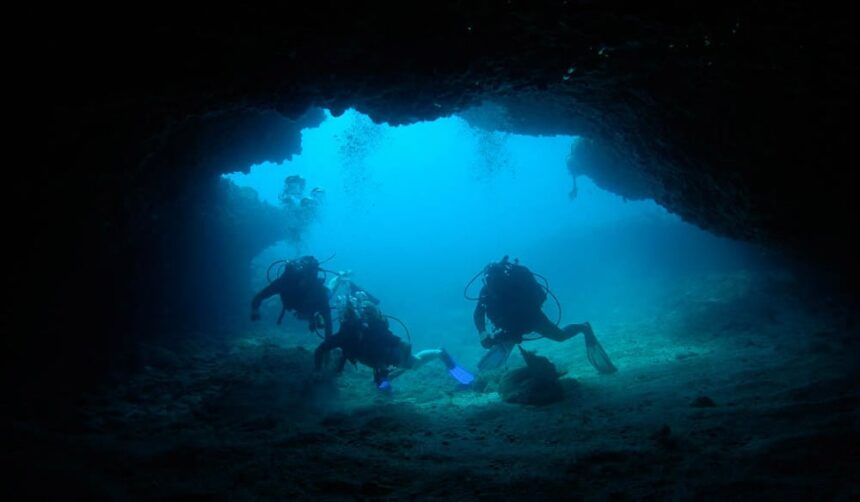
Three scuba divers silhouetted at the mouth of a dark underwater cave in Guadeloupe

The most iconic dive site in Guadeloupe is the Grotte aux Baracudas that is a gorgeous blue cave. It has become the home to a massive school of barracudas who swirl around in the blue. The depth makes this dive site an advanced spot and ideal for any experienced divers to witness the underwater wonder.

  • One of the favorite dive spots of Jacques Cousteau
  • Features plenty of Barracudas
  • Great spot to see invertebrates

What you will see: Apart from the iconic barracudas, you will also have the chance to spot spiny lobsters and other crabs hiding in the cracks and cervices in the cave. There are also plenty of starfish, and other invertebrates camouflaged in the dark. There are also moray eels, frogfish, reef fish, and rays.

L’Augustine Fresnel
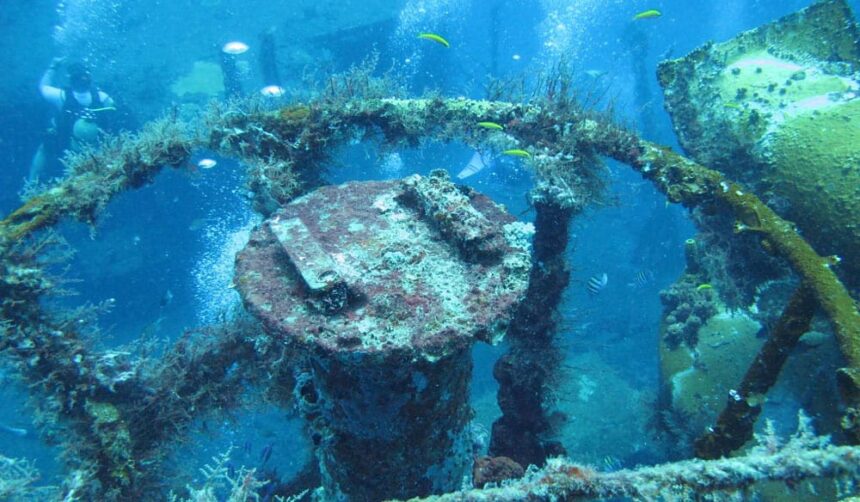
Coral-encrusted wreck structure of the Augustine Fresnel with divers exploring in the background

The 173 ft Augustin Fresnel ii was originally a lighthouse ship that was assignment to the center of Pointe a Pintre during the early 1990s. It was placed there to keep the area safe during the maintenance of the buoys in Antilla and Guyana. During a hurricane season, it was however moved to Guadeloupe and sunk at a depth of 82 ft in 2003. A particularly strong hurricane, Hurricane DEAN pushed the whole wreck deeper into 108 ft. It is now a spectacular artificial reef, and a great spot for advanced and wreck specialty divers.

  • A deep dive site for advanced divers
  • Is a home to two large groupers
  • Purposefully sunk for scuba divers and scientific divers

What you will see: The wreck has attracted plenty of species to it. There are groupers, tunas, barracudas, and sting rays that can be frequently seen on dives. The metal structure itself has been colonized by coral growths and provides divers a fantastic backdrop to a unique and safe dive. Enjoy your dive through the hundreds of swallowtail perch swarming around.

Point Lézarde
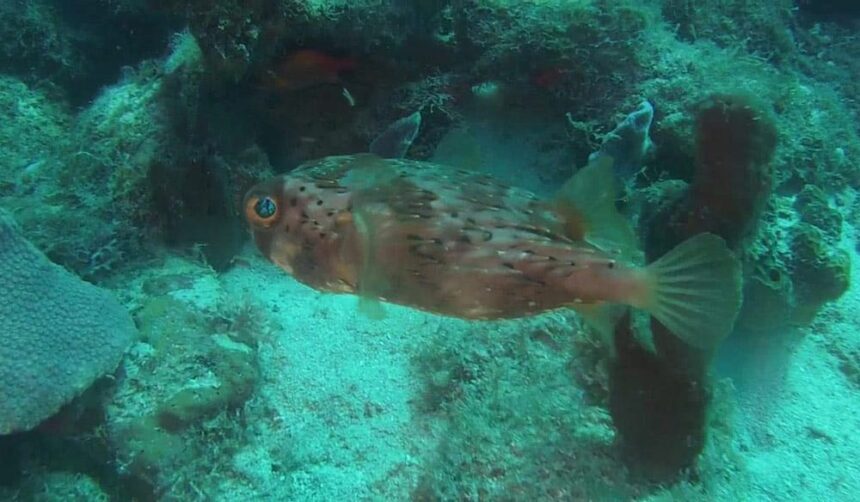
Spotted porcupinefish hovering beside coral heads and sponges on a reef in Guadeloupe

This dive site can be spotted from above the surface as a little patch of dry land rising from the water. The drop off from the surface features plenty of sponges, and a gradual descent to 130 ft where the drop off is drastic. Bouillante is well known for its volcanic and geothermal activity, that makes this a fascinating dive site featuring hot springs bubbling from the seabed.

  • Geothermal activity causes hot springs to bubble from the seabed
  • Deep dive for advanced divers
  • Unique topography and marine life can be found here

What you will see: The uniqueness of this dive site means you will come to face with an interesting collection of sea life. You will be able to spot crustaceans and fish including firefish volitans, a trevally, groupers, barracuda, octopus and punctuated char. The bubbles rising from the jagged reef are also warm, providing you with additional spouts of hot water in the already warm environment. There are also frequent sightings of turtles and dolphins.

Sec Pate (Les Saintes)
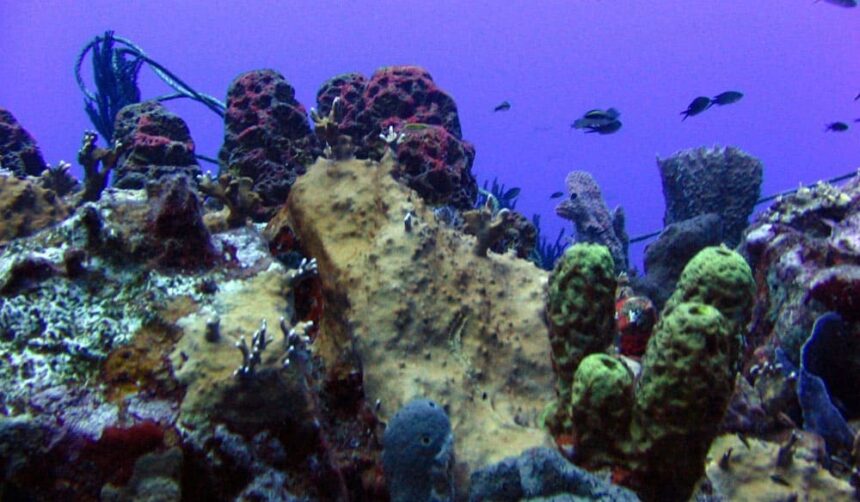
Red, green and yellow sponges covering a reef ridge with fish in the deep blue water beyond at Sec Pate

This dive spot is better suited for advanced open water divers as there are frequently strong currents in the area. The Sec Pate dive site is located around the underwater pinnacle reminiscent of a row of witches’ hats. This dive site is in the channel right off Les Saintes.

  • The three underwater peaks attract a variety of fish life
  • The strong currents in this area are best suited for experienced divers
  • Keep a look out for sting rays and green moray eels!

What you will see: This dive spot has a large variety of healthy coral growing on the underwater pinnacles grabbing nutrients from the current. See if you can spot the iconic black coral, or diverse types of sponges. The reef in the area is the home to many angelfish, little rays, damselfish, and the occasional green moray eel peering out from under a rock. There are also lizardfish, stone fish, cuttlefish, goat fish, tunas, and groupers swimming around!

The Quecy Point
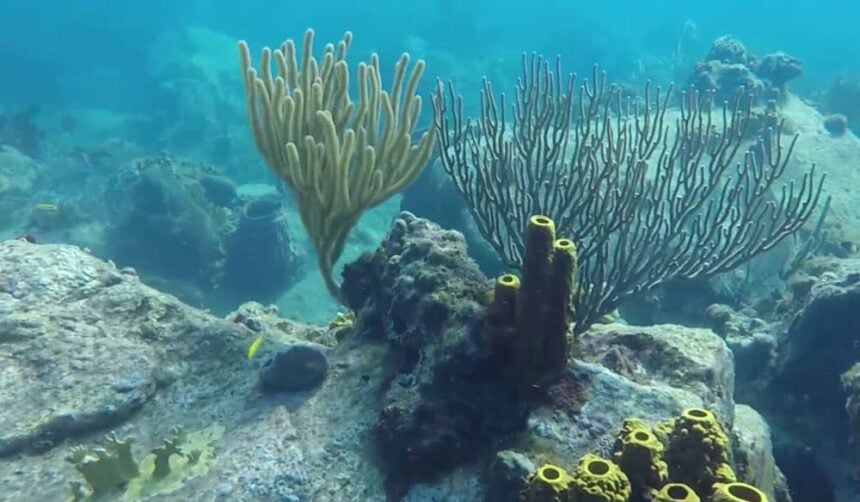
Sea plumes and yellow tube sponges growing over a rocky reef south of Bouillante, Guadeloupe

This dive site is located a short distance from the popular town of Bouillante. It is a relatively shallow dive with an incredible biodiversity of marine animals. The site leads divers along a reef towards a small cave. There is also a volcanic pipe that can you can swim through to offer an alternative perspective on the underwater world.

  • Divers can swim through a volcanic pipe at this dive site
  • Shallow water well suited for beginner and intermediate divers
  • Typically, minimal current, but plenty of marine life.

What you will see: The small cave is the home to many interesting and well camouflaged critters. Bring a dive torch and see how many species you can find in the dark, with their shining eyes reflecting your torches light. There will be cleaner shrimp, crabs, spiny lobster, and sometimes a moray eel.

Jardin de Corail
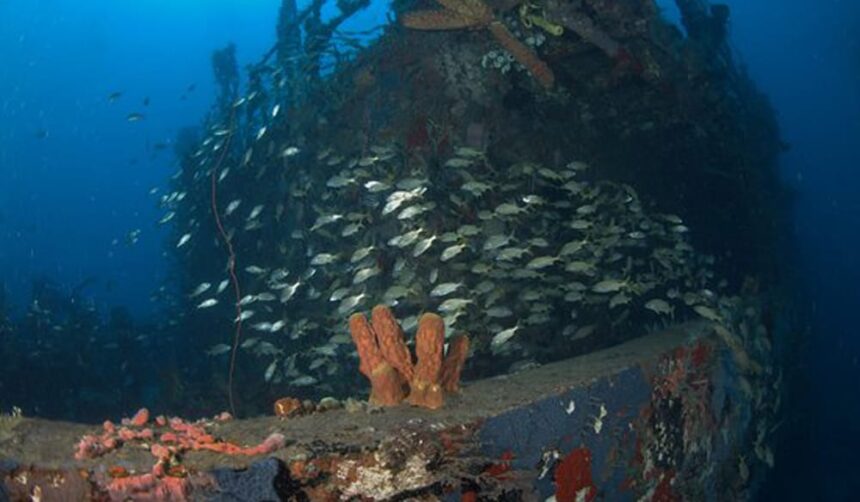
Shipwreck hull crusted with sponges and surrounded by a dense school of silvery fish in Guadeloupe

This spectacular coral garden is in the Cousteau reserve, and is the home of some of the most beautiful coral in the area. The reef can begin at a depth of 6 ft and descends to 150 ft. Divers of any level will be able to explore the coral at their preferred depth.

  • Iconic dive site within the Cousteau reserve
  • Great opportunity for photographers of macro fauna
  • Go down and check a 36-foot statue of Jacques Cousteau

What you will see: There are plenty of species of coral, including hard and soft corals. There are gorgonian fans along with sponges scattered among the reef wall. The marine animals in this area include jackfish, sea turtles, and stingrays. For real crowd pleasure, head over to the 36-foot-tall statue of Cousteau located on the sand.

The Gustavia
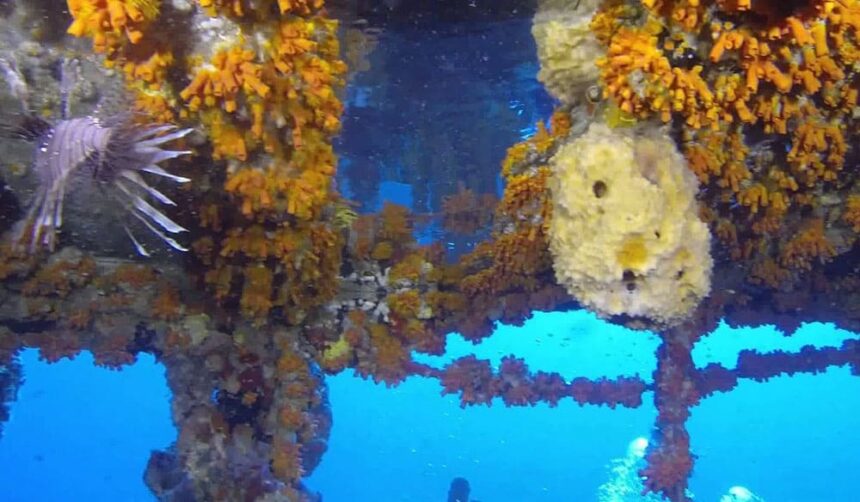
Lionfish beside wreck beams thick with orange cup coral and sponges at the Gustavia site in Guadeloupe

Just like many other ships in the area, the coaster La cascade-Michaux got battered by a strong hurricane in 1991. Hurricane Hugo made it impossible for this ship to return to sea, and instead it was sunk to a depth of 127 ft. It is now located a short boat ride away from Pigeon Island and is teeming with sea life.

  • Deep dive for advanced divers
  • Plenty of curious fish surround divers on each dive
  • One of the three purposefully sunk wrecks in Guadeloupe

What you will see: Around the safety stop, there are frequently hundreds of curious barracudas who swirl around divers on every dive. The wreck itself is covered with sponges and soft corals. There are plenty of angel fish, and other schooling fish dancing around the sunken ship and providing a beautiful display for divers. The sandy areas surrounding the bottom of the wreck are covered in eels peeping out, along with the occasional sting ray almost invisible in the sand.

Grand Cul-de-Sac Marin
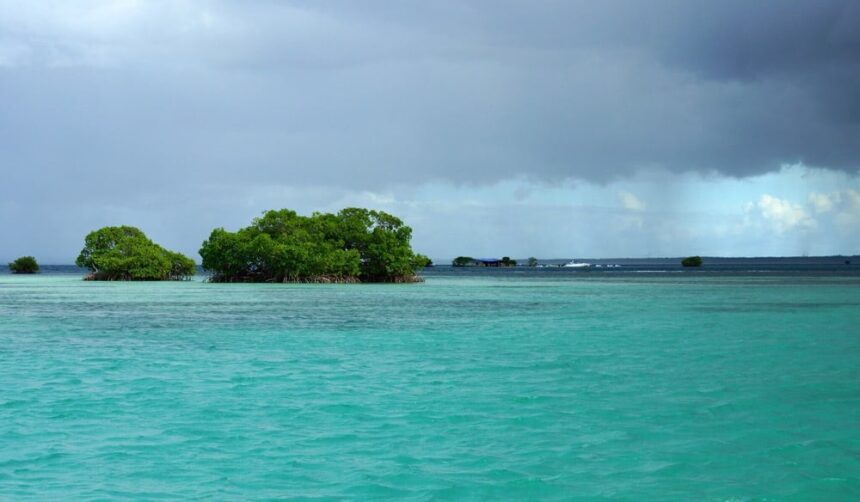
Mangrove islets in shallow turquoise water under a heavy storm sky at Grand Cul-de-Sac Marin, Guadeloupe

The Grand Cul de Sac is in the natural reserve between Grande-Terre, and Basse-Terre. The natural reserve means that all species of animals, and plants are protected here allowing them to thrive. The reef stretches a long distance, with plenty of spots where divers can hop in and begin their dive.

  • Located in a marine protected area
  • There are seagrass beds near the coral reef
  • Great dive spot for macro photography

What you will see: Among the rich coral reef, you will find all the usual suspects including angelfish, damselfish, lionfish, frogfish, moray eels, goatfish and more. There are also sting rays that can either be spotted swimming around the sand, or well camouflaged on the bottom of the sea. The seagrass and mangrove swamps are also beloved destination for small fish, as these areas are protected nurseries for juveniles.

Jardin Japonais (Japanese Garden)
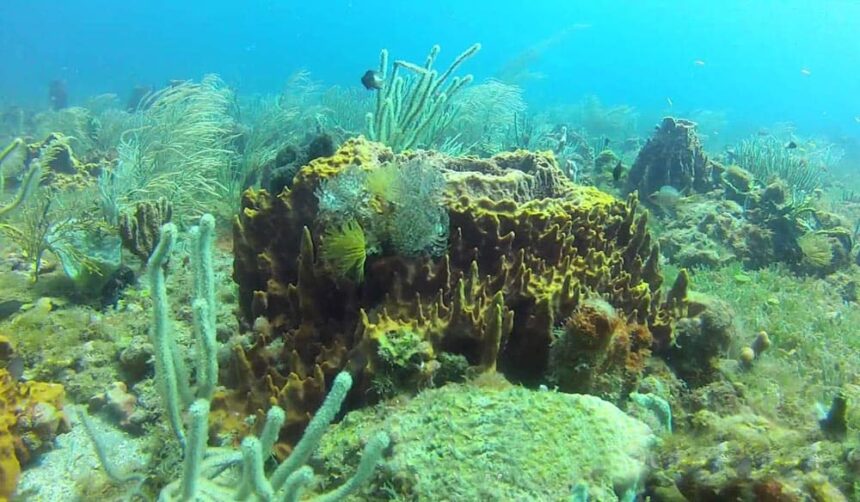
Yellow tube sponges and sea rods covering a reef mound in clear blue water at Jardin Japonais, Guadeloupe

The Jardin Japonais (the Japanese Garden) is located off the coast of Grande Terre. It is a popular dive spot for beginner divers, as well as snorkelers and swimmers. The dive site is shallow, there are minimal currents, and the healthy corals make it an ideal destination! The Japanese garden is a collection of rocks and sand bars where marine creatures play hide and seek in the topography. There is an arch located at 32 ft in depth.

  • Great spot for snorkelers and beginner divers
  • The shallow reef gives amateur photographers a great chance to practice and play around
  • Abundant coral and marine animals

What you will see: This healthy coral reef is the home to angelfish, damselfish, butterfly fish, wrasse, goatfish, moray eels, sting rays, crabs, brittle stars, and cleaner fish. There are also gorgonian fans, hard corals, soft species, and sponges! Keep an eye into the blue, as you will be able to potentially spot tuna, or barracuda!

The Aquarium
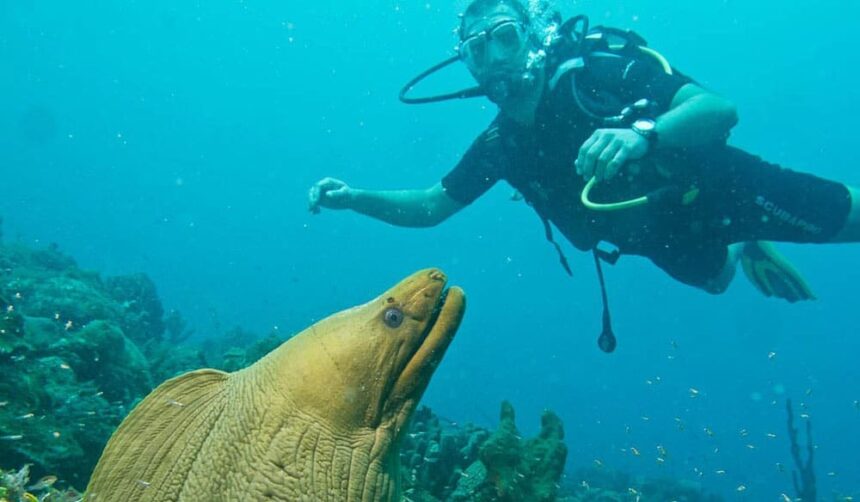
Green moray eel rearing up from the reef with a scuba diver hovering behind it at The Aquarium, Guadeloupe

This beginner friendly dive site begins at a shallow depth and descends to greater depths for more advanced divers. The shallow depth of this dive site also means it’s a great place to practice photography and have a nice long dive.

  • Great dive spot for photographers
  • Varied depths suited for beginner or more experienced divers
  • Plenty of sea turtles living in this area

What you will see: This dive site is the home to plenty of fish, including frogfish, damselfish, stonefish, triggerfish, and pelagic. If you are a fan of sea turtles, then this is a great dive spot for you. You can frequently see these creatures gracefully swimming over the reef, taking naps under ledges, or swimming up to the surface for a gulp of air. If you want to have a fantastic turtle experience, do not make eye contact with it, as that will allow you to approach it closer without threatening it.

Le Franjack
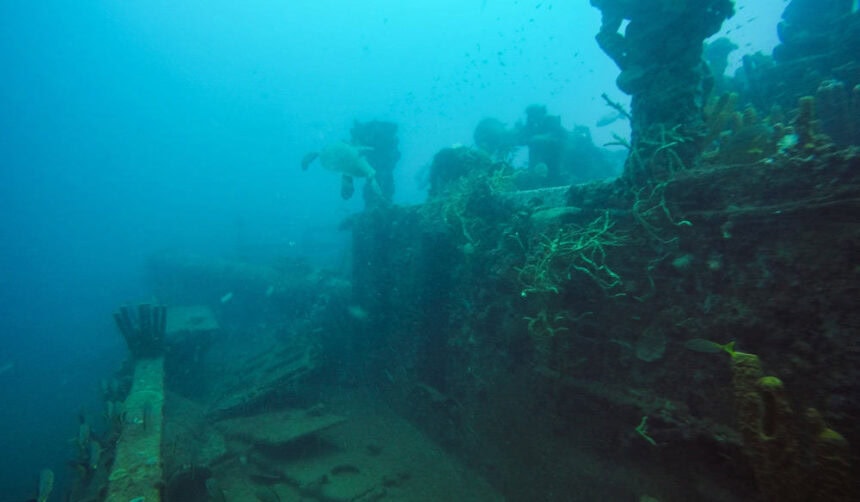
Diver swimming along the encrusted deck rail of the Franjack wreck in Guadeloupe

The Franjack is a wreck that was sunk in 1996 to create an artificial reef for divers in Guadaloupe. Along with Le Gustavia and Láugustin Fresnel ll It is one of the three wrecks located in the Archipelago. Le Franjack is a 50m long ship that now rests on its port side following the storm Berta. The wreck is in a located in a shallow dive site, so it is well suited for any level of diver.

  • Intermediate dive site at an artificial reef
  • One of the three wrecks in Guadaloupe
  • Covered in coral growths and marine animals ideal for photography

What you will see: The wreck is located on a sandy patch at a depth of 78 ft. The wreck is beautifully overgrown with hard corals, soft corals, and gorgonian fans. While swimming around, you will see schools of fish swirling around the eerie metal skeleton. There are trigger fish, grunts, damsel fish, and crabs that can be seen on any given dive. There are also spiny lobsters, sting rays, and crabs hiding among the coral growth.

La Piscine
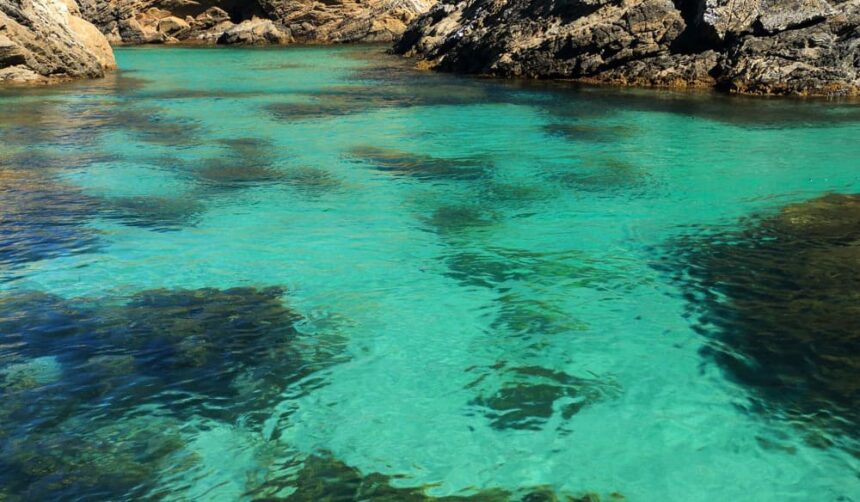
Shallow turquoise water over rock and seagrass patches in a sheltered rocky cove at La Piscine, Guadeloupe

La Piscine is known as “The Pool” in English, and certainly simulates pool like conditions in the open water. It’s a great dive spot for beginner divers, or divers who wish to have a refresher. Scuba training is frequently conducted in this area since there is a large white sandy patch.

  • Shallow sandy bottom area ideal for dive training
  • Proximity to coral reef allows you to learn to dive in a beautiful environment
  • Great spot for a first dive after a long break

What you will see: This shallow dive spot has a stunning coral reef teeming with life. See how many different butterfly fish, damsel fish, or other reef fish you can spot swimming around. There are also plenty of eels hiding in cracks in the reef, and well camouflaged crabs tightly jammed inside coral.

Point Carrangue
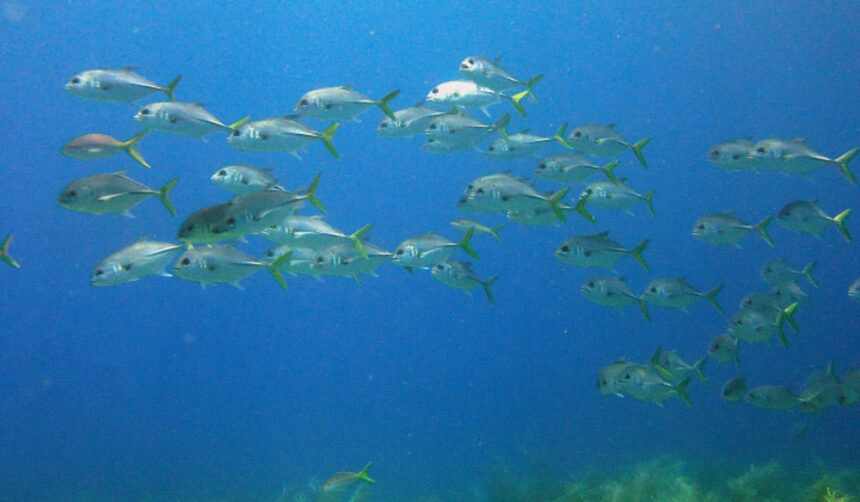
School of horse-eye jacks cruising through open blue water above a patch of reef

This stunning dive site is located in a calm bay, and typically has visibility up to 98 ft. Open Water divers are welcome at this dive spot to explore the beautiful coral reef bommies, and plateaus covered in fish life.

  • Dive site well suited for any levels of diver
  • Depth can descend down to 40m, so stick to your certification level
  • Healthy coral reef is the home to plenty of marine animals

What you will see: The coral reef is the home for turtles, tunas, groupers, lizard fish, sea urchins, trumpet fish, and anemone fish! Sting rays also frequent this area and provide a beautiful subject for photographer. If you are interested in seeing some moray eels, make sure to check crevasses and under ledges for these shy creatures. See how many trevallies you can spot, as that is what this dive site is named after!

Point Malendure
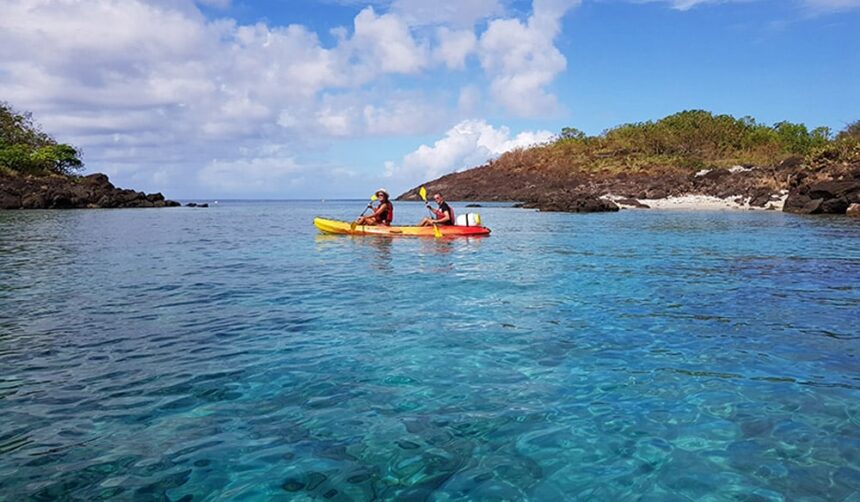
Two kayakers paddling across clear turquoise water beside a rocky green headland at Point Malendure

The point Malendure offers divers the chance to dive among several large rocks located at a relatively shallow depth. These rocks are the home to plenty of fish life, and interesting growths on the coral. Typically, there is not much of a current making the dive site well suited for most dive levels. Unfortunately, the visibility tends to be low.

  • Unique underwater topography
  • Plenty of marine life can be found in this area
  • Great place to spot macro fauna

What you will see: The rocks are a popular spot for plenty of barracudas, snapper, cassava, and lionfish to swim around and hunt in the area. It is almost worth not moving much, and simply observing these beautiful fish darting around the place. The seabed is also teeming with sea urchins, and other small invertebrates.

Point Mahaut (Point Noir)
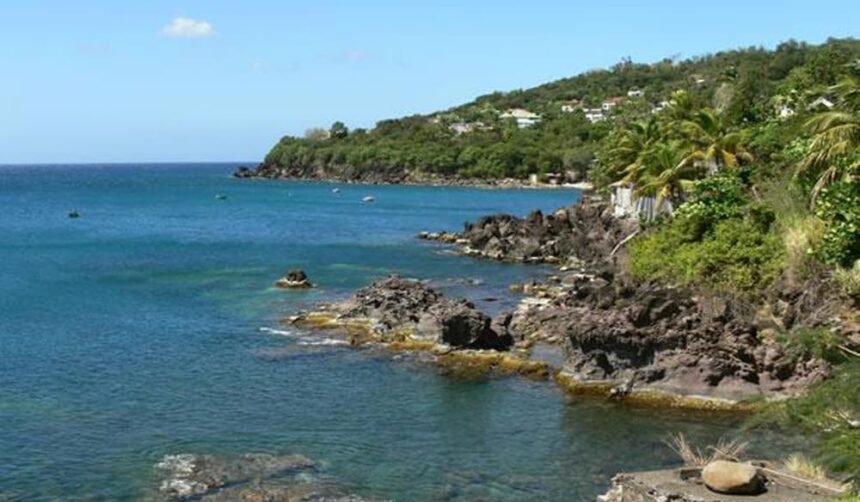
Rocky volcanic shoreline with palms and green hills above calm blue water in Guadeloupe

Another fascinating collection of rocks located at a comfortable 65 ft is a great dive site for intermediate divers. There is an abundance of marine animals all along the rocky structures. This is a great dive site to have a long dive and see how many marine critters you can identify.

  • Well suited for intermediate divers
  • Brimming with sea life around every rock
  • Great spot to practice photography

What you will see: The typical reef fish can all be seen swimming around the rocks including parrotfish, butterfly fish, and surgeon fish. These are spectacularly colored and can be fantastic subjects for your photograph. If you wish to test your identification skills, see what well camouflaged animals you can find. This dive spot has plenty of stone fish, lionfish, trumpet fish, sea horses, and frogfish hiding away from plain site.

Apart from scuba diving, there are also plenty of land-based activities to partake in during your non dive days. Why not visit the botanical gardens? Wander through the jungle? Or stop at the Maison du Cacao and learn about the creation of chocolate?

When to go to Guadeloupe

The temperatures throughout the year remain warm, with the water hardly dipping below 68 °F. This makes the islands an ideal destination for snorkelling, diving, and other water related activities. The air temperature fluctuates between 68 °F in January, to 75 °F in June. Typically, there is more rain during the summer months, while the dry season stretches from December until April. This makes it the ideal time to visit the island. Warm temperatures, no rain, and clear visibility for the perfect scuba holiday. Unfortunately, particularly during the Christmas and new years season, many tourists flock to this part of the world, so prices do increase.

What are your favorite dive sites in the Guadeloupe? Did we miss anything important? Drop us a comment below and let us know why you love diving in the Guadeloupe!

Subscribe
Notify of
guest
guest
0 Comments
Take a momnent Take a moment to look at this.
It's genuinely free…
Look at this
Shearwater Newsletter Form (widget sidebar) (#26)

Join our newsletter to win:

Free Scuba Gear!

We’ve partnered with Shearwater Research and are giving away a brand new Shearwater Peregrine TX with a Swift GPS Transmitter.

To enter the competition – Join the DIVEIN and Shearwater newsletters:

You can always unsubscribe for free
Learn more about our giveaways here!

Most read this week:

Green hills and a turquoise bay full of sailboats in Martinique, under text reading The Best Dive Sites in Martinique

15 Best Dive Sites in Martinique in 2026

Cliffside Puerto Rico coastline with old fort walls and city buildings under text reading The Best Dive Sites in Puerto Rico

15 Best Dive Sites in Puerto Rico in 2026

Limestone karst islands rising from green water in Vietnam under text reading The Best Dive Sites in Vietnam

20 Best Dive Sites in Vietnam in 2026

Yellow lifeguard hut on a white sand Barbados beach under text reading The Best Diving Sites in Barbados

20 Best Dive Sites in Barbados in 2026

Aerial view of Grenada's colourful hillside town and waterfront rising above a turquoise harbour

15 Best Dive Sites in Grenada in 2026

Sunlit Dominican Republic beach with leaning palms, white sand and turquoise surf under bright cloud

Top 15 Best Dive Sites in Dominican Republic in 2026

Aruba beach with swimmers in turquoise shallows, mossy rocks in the foreground and resorts along the shore

15 Best Dive Sites in Aruba in 2026

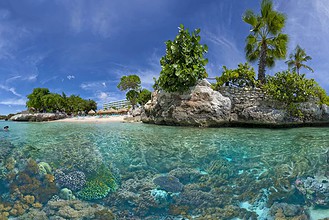
Split-level view of a shallow coral reef below a palm-lined Curacao beach and rocky shoreline

Top 15 Best Dive Sites in Curacao in 2026

Show More

DIVEIN.com was founded in 2009 by the two brothers Torben and Nicolai.

We’re a free review guide – run by passionate Divers, Sports, and Outdoor fanatics.

Follow Us

YOUTUBE
FACEBOOK
INSTAGRAM

Our reviews: We can make the world a little bit better with great in-depth reviews.

Why? Because great in-depth gear reviews will help you select the right products for your specific needs, budget, and interests. And when you have the right product, you’re a little bit happier which affects the people around you!

Income disclosure: We are reader supported, and may earn affiliate commissions when you buy via links found on DIVEIN.com: If you find a good deal on our site, you click to the retailer and you buy the product, we get a commission of the sale. This is how we pay ourselves. It does not make the product pricier for you.

All content is copyright protected by either DIVEIN.com or respected copyright holders – © 2026

Your rights:

California Residents: Do Not Sell My Personal Information
EU Residents: If you have a dispute, you can use the Online Dispute Resolution platform. Our data practices comply with the GDPR.
Australian Residents: Your consumer rights are protected under the Australian Consumer Law (ACL).
Canadian Residents: Our data practices comply with PIPEDA.
UK Residents: Your rights are protected under the Consumer Rights Act 2015.

About this image

Related to:

wpDiscuz