










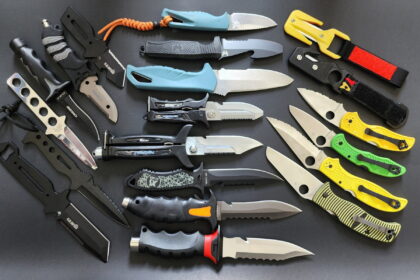








































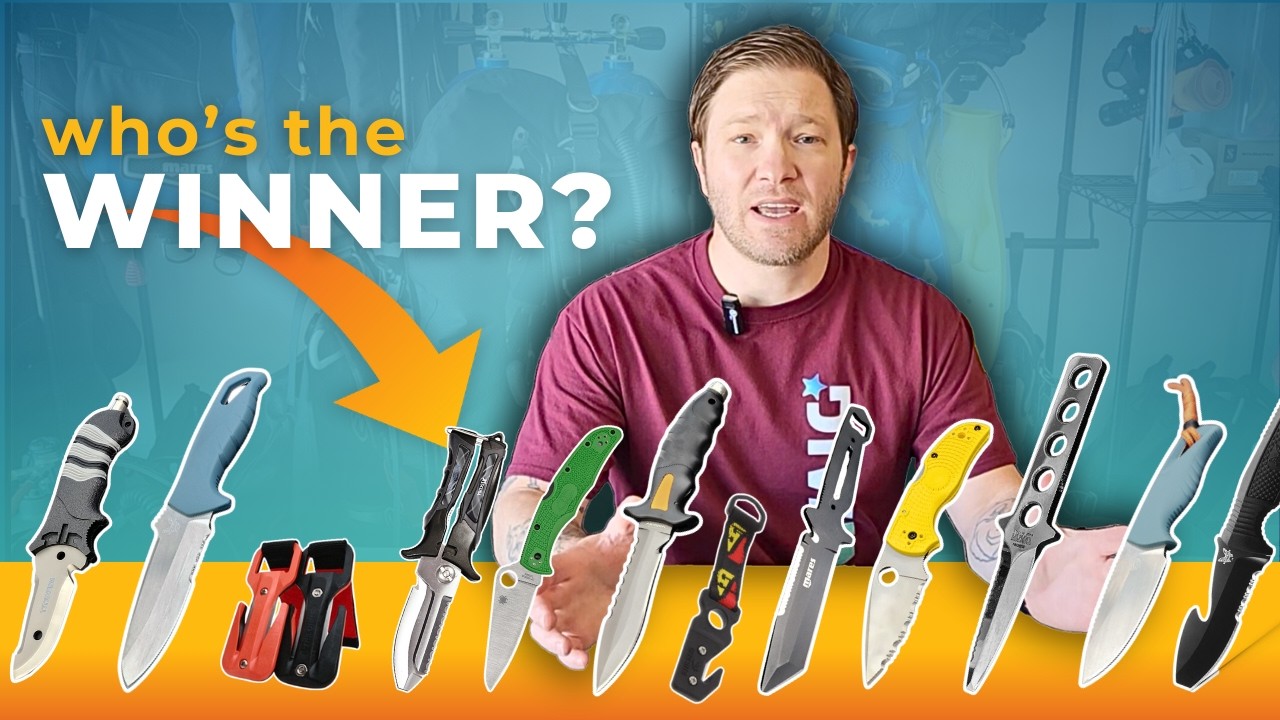


Dive knives vary widely in real-world performance, and not all models deliver the same cutting power, accessibility, or reliability when you need them most. Differences in blade design, materials, and sheath systems can significantly impact how effectively a knife handles common hazards like fishing line, rope, and webbing underwater.
At DIVEIN, our team has tested more than 20 dive knives using consistent, hands-on methods designed to reflect real diving scenarios. Each knife was evaluated for cutting performance and sheath accessibility, tested both bare-handed and with wreck gloves, 3mm neoprene gloves, and thick 5mm gloves. We also cut through monofilament, paracord, and braided nylon to assess performance across different materials. Based on this testing, we selected the best dive knives for 2026 to help you choose a reliable option for safety and everyday diving use.
Benchmade H2O


Where to buy
Track this priceBenchmade H2O Dive Knife review
It’s not very often that a small machine shop grows into one of the leading manufactures of world-class knives. But that’s the Benchmade story. From outdoor to everyday carry to tactical knives, it’s hard to beat the quality you’ll find in every one of the million-plus knives Benchmade produces every year
Made in America, the H2O, designed for elite military units, is one of the best aquatic knives on the market. Made from N680 Ultra stainless steel, and featuring three cutting edges, the H2O is ready for your next dive adventure.
Let’s dive in and take a closer look at the Benchmade H2O fixed dive knife.
SEAC Tajaman


Where to buy
Track this priceSEAC Tajaman Dive Knife review
Based in Italy, SEAC makes affordable scuba and freediving equipment for divers around the world. Along with scuba and freediving, they also specialize in spearfishing. Their equipment is nice and well built. The SEAC Tajaman dive knife is one of those pieces of equipment we really enjoy.
A solid, one-piece design, made from 420 stainless steel, the Tajaman is a great knife at an even better price. It comes with a lightweight fabric sheath that is strong and secure.
Let’s dive in and take a closer look at the SEAC Tajaman Dive Knife.
XS Scuba Mini FogCutter X Dive Knife


Where to buy
We compare prices daily across all major online stores.
See all 4 pricesXS Scuba Mini FogCutter X Dive Knife Dive Knife review
Do you ever go out on a dive and need a knife, scissors, and a line cutter? We can think of a few dives where having each of those tools would have come in handy. Now, with the XS Scuba Mini FogCutter X you can have all those tools in one compact piece of equipment.
Two cutting edges, a straight edge, and a serrated edge, not to mention a line cutter and medical grade shears, all built into a multi-tool dive knife. Standard with a blunt tip that doubles as a screwdriver in a pinch, the Mini FogCutter is like having a Leatherman for diving.
Let’s dive in and take a look at the XS Scuba Mini FogCutter X dive knife.
Spyderco Salt 2


Where to buy
Track this priceSpyderco Salt 2 Dive Knife review
Not many people immediately think of Spyderco when they think of diving, but everybody thinks of quality when they think about Spyderco. For over four decades, Spyderco has been a leader in the cutlery industry. Hunters, fishers, hikers, backpackers, and campers have known for years that Spyderco knives are sharp, strong, and dependable.
We recommend you check their line of knives out for diving as well. Made from stainless steel and a fiberglass reinforced nylon handle, the Spyderco Salt 2 can handle the toughest saltwater you can throw at it. Plus, it’s small enough to fit anywhere you want to stash it, and strong enough to count on when the time comes.
Let’s dive in and take a closer look at the Spyderco Salt 2 Dive Knife.
Benchmade Undercurrent


Where to buy
We compare prices daily across all major online stores.
See all 3 pricesBenchmade Undercurrent Dive Knife review
Over a million blades are made every year from over 300,000 pounds of steel and sharpened in Oregon, USA. It’s what sets Benchmade apart—the dedication to make great knives for discerning buyers. People think Benchmade just means outdoors, hunting, tactical, and everyday knives. But with the new Water line, you can now use your favorite brand under and on top of water.
Sharp out of the box, durable, and great looking, the Benchmade Undercurrent is the perfect boat knife, but one that comes with leg straps so you can take it diving with you. A comfortable Santoprene handle and a sharp sheepsfoot blade make the Undercurrent a cut above.
Let’s dive in and take a closer look at the Benchmade Undercurrent dive knife.
Akona Talon


Where to buy
We compare prices daily across all major online stores.
See all 4 pricesAkona Talon Dive Knife review
Around here we are huge fans of Akona wetsuits and gear bags. Everybody knows the frog logo, and they know it means quality. The Akona Talon dive knife just made our list of great products from Akona. If you’re looking for affordable, high-quality equipment, look no further.
The Akona Talon is a traditional, fixed-blade dive knife. It’s a larger knife, but one with great balance and a titanium blade, which means it’s perfect for divers who are in the water all the time. And it has a great price point, making it a great knife for the wallet-conscious diver.
Let’s dive in and take a closer look at the Akona Talon dive knife.
EEZYCUT Trilobite Line Cutter


Where to buy
We compare prices daily across all major online stores.
See all 3 pricesEEZYCUT Trilobite Line Cutter Dive Knife review
Fast, simple, and reliable are qualities all divers want in their gear, and those are exactly what the EEZYCUT Trilobite delivers. Sold at a very reasonable price, the EEZYCUT Trilobite is a great addition to any dive kit. Even if you have a knife, it’s smart to have the Trilobite on hand as a backup.
Made from 440A stainless steel and plastic with steel screws, the EEZYCUT Trilobite will last for a long time. It comes in various colors and a few different designs. It can cut fishing line and ropes up to just under half an inch.
Let’s dive in and take a closer look at the EEZYCUT Trilobite line cutter.
Dive Rite Line Cutter


Where to buy
We compare prices daily across all major online stores.
See all 4 pricesDive Rite Line Cutter Dive Knife review
We love the simplicity of the entire Dive Rite line. That’s not to say that their equipment is “simple,” but it is condensed. They don’t have a multitude of different regulators; they sell one fin set; and they have just a small variety of BCD setups. One thing is for sure, though— it’s all high-quality, and that goes for the Dive Rite Line Cutter too.
This tool is simple, easy to access, attachable almost anywhere on your gear, and really affordable. Made from high-quality surgical-grade stainless steel and fiber-reinforced nylon, the Dive Rite Line Cutter is one accessory you can’t pass up.
Let’s dive in and take a closer look at the Dive Right Line Cutter.
Spyderco Native 5 Salt


Spyderco Native 5 Salt Dive Knife review
A lot sets Spyderco apart from its competitors, not least of which is the distinctive hole you’ll see on the blade. This simple yet innovative design is one of many reasons Spyderco is a leader in the knife industry. Designed to open quickly and swiftly with one hand, Spyderco knives are sharp out of the box, feature two distinct cutting edge designs, and a multitude of blade models to choose from.
One of the best all-around knives, the Native 5 Salt is designed for everyday use, but still functions as a dive knife. It’s available in both flat and SpyderEdge blade designs as well two colors. You’ll not only be glad you have it on your dive trip, you’ll also be happy it’s clipped in your pocket everyday.
Let’s dive in and take a closer look at the Spyderco Native 5 Salt dive knife.
Promate Sharp Tip Titanium BC Dive Knife


Where to buy
Track this pricePromate Sharp Tip Titanium BC Dive Knife Titanium Knife review
Promate believes diving is a universal sport for everyone to enjoy. That’s why they make affordable, high-quality equipment. The Promate Sharp Tip Titanium BC knife fits their ethos perfectly— a highly affordable knife that delivers far beyond its cost.
Made from titanium, this knife will last for years. It’s the perfect size for travelers or any diver looking to streamline their gear. The connection choices are almost unlimited—attach it to your belt, a shoulder strap on your BCD, or even onto your inflator hose.
Let’s dive in and take a closer look at the Promate Sharp Tip Titanium BC dive knife.
Benchmade Intersect


Where to buy
We compare prices daily across all major online stores.
See all 3 pricesBenchmade Intersect Dive Knife review
When people think of quality knives in general, not just dive knives, they think of only a handful of brands, and Benchmade is near the top of that list. But when people think of dive knives, for some reason they don’t have the same thought. We’re here to tell you to change your thinking. The entire water series from Benchmade is top-notch, and that includes the Intersect.
The Intersect is a great knife for traveling. It’s lightweight and can fit right on your BCD. The MagnaCut stainless steel and fixed blade means it’s tough and can handle anything you throw at it. It’s sharp, both in cutting capabilities and design.
Let’s dive in and take a closer look at the Benchmade Intersect dive knife.
Tektite Tekna Ocean Edge


Where to buy
Track this priceTektite Tekna Ocean Edge Dive Knife review
Tektite is, and has been, a leader in the tactical light industry for quite some time. With their acquisition of the Tekna brand, Tektite also became involved in the knife industry.
They manufacture a handful of diving-related knives, and the Ocean Edge is a great knife from their line. Based on the same original Tekna model, the Ocean Edge has been trusted by divers and outdoor enthusiasts for years.
With the option between stainless steel or titanium, as well as the option of blunt or sharp tip, the Ocean Edge can be designed to fit your needs. Standard with both a black and an orange sheath, the Ocean Edge can be attached just about anywhere you want to put it.
Let’s dive in and take a closer look at the Tektite Tekna Ocean Edge dive knife.
Cressi Predator


Cressi Predator Dive Knife review
Cressi has been producing great equipment since 1946, from BCDs to regulators, from fins to masks. One of our favorite travel BCDs comes from Cressi—we absolutely love the Cressi Aquawing. It’s lightweight and great for travel. We also really like the Cressi Predator dive knife—it’s small and ready for travel with a sharp edge.
Made from 420 stainless steel and measuring roughly seven inches, the Predator is made with adventure-seeking traveling divers in mind. A comfortable handle and a sheath you can attach to almost any piece of equipment make the Predator a great back-up knife.
Let’s dive in and take a closer look at the Cressi Predator dive knife.
Mares Maximus


Where to buy
We compare prices daily across all major online stores.
See all 3 pricesMares Maximus Dive Knife review
Mares makes some of the most top-rated gear on the market, including the ever-popular Avanti Quattro + fins and the Prestige SLS BCD. But they also make some of the best accessories in the scuba space. The Mares Maximus dive knife is one of those accessories.
The Maximus is made from 440 stainless steel, and features a straight edge, serrated edge, a line-cutter, screwdrivers, and a bottle opener. While some of these add-ons might be niche, the knife itself is sharp and durable.
Let’s dive in and take a closer look at the Mares Maximus dive knife.
Promate Barracuda Sharp Tip Titanium


Promate Barracuda Sharp Tip Titanium Dive Knife review
Promate believes diving is a universal sport for everyone to enjoy. That’s why they make affordable, high-quality equipment. The Promate Barracuda Sharp Tip Titanium knife fits their ethos perfectly—a highly affordable knife that delivers far beyond its cost.
Made from titanium, this knife will last for years. It’s the perfect size for divers who prefer a larger knife and prefer to wear it on their calf. Nice balance, finger-grip molds, straight and serrated edges, and an easily accessible locking mechanism make the Barracuda a great knife.
Let’s dive in and take a closer look at the Promate Barracuda Sharp Tip Titanium dive knife.
Spyderco Stretch 2XL Lightweight Salt


Where to buy
We compare prices daily across all major online stores.
See all 3 pricesSpyderco Stretch 2XL Lightweight Salt Dive Knife review
Not many people immediately think of Spyderco when they think of diving, but everybody thinks of quality when they think about Spyderco. For over four decades, Spyderco has been a leader in the cutlery industry. Hunters, fishers, hikers, backpackers, and campers have known for years that Spyderco knives are sharp, strong, and dependable.
We recommend you check their line of knives out for diving as well. Made from stainless steel and a fiberglass reinforced nylon handle, the Spyderco Stretch 2XL Lightweight can handle the toughest saltwater you can throw at it.
Let’s dive in and take a closer look at the Spyderco Stretch 2XL Lightweight dive knife.
XS Scuba Neuro


Where to buy
We compare prices daily across all major online stores.
See all 5 pricesXS Scuba Neuro Dive Knife review
We would wager to guess that nearly everybody reading this has a piece of equipment from XS Scuba—they are that good at making equipment that’s useful for everybody. We personally love their line of accessories, but other divers find use in their big-ticket items as well, especially in the Highland line. The XS Scuba Neuro knife is one of those pieces of equipment we really like.
Built with stainless steel and a chromium coating, the Neuro dive knife will last for a long time, and at the price it sells for you’d be silly not to run out and buy it. Coupled with one of the smoothest sheath release systems, and having both a straight and serrated edge the Neuro knife is great.
Let’s dive in and take a closer look at the XS Scuba Neuro dive knife.
XS Scuba FogCutter X


Where to buy
We compare prices daily across all major online stores.
See all 5 pricesXS Scuba FogCutter X Dive Knife review
Do you ever go out on a dive and need a knife, scissors, and a line cutter? We can think of a few dives where having each of those tools would have come in handy. Now, with the XS Scuba FogCutter X you can have all those tools in one piece of equipment.
This tool features two cutting edges, a straight edge, and a serrated edge, not to mention a line cutter, medical grade shears, and a pipe grip all built into a multi-tool dive knife. With either a blunt tip that doubles as a screwdriver in a pinch or a pointed tip, the FogCutter X is like having a Leatherman for diving.
Let’s dive in and take a look at the XS Scuba FogCutter X dive knife.
Mares Neutron


Where to buy
We compare prices daily across all major online stores.
See all 3 pricesMares Neutron Dive Knife review
Mares makes some of the most top-rated gear on the market, including the ever popular Avanti Quattro + fins and the Prestige SLS BCD. But they also make some of the best accessories on the market. The Mares Neutron Dive knife is one of those accessories.
The knife is made from 440 stainless steel, and features a straight edge, serrated edge, a line-cutter, and screwdrivers. While some of these add-ons might be niche, the knife itself is sharp and durable.
Let’s dive in and take a closer look at the Mares Neutron dive knife.


How We Test: Dive Knives
Why trust us
Since DIVEIN began 15 years ago, we have tried and tested gear from all the major players—Shearwater, Cressi, Suunto, Garmin, Oceanic XS Scuba—in all shapes and sizes. All of the knives we tested were submitted for review, and we are never paid to write a falsely glowing review of a product.
All of our reviews are unbiased and our selections are the result of thorough testing and our dive team’s knowledge from a combined 50 years of diving experience. We have curated a list of the top dive knives according to different wants, needs, and budgets, so no matter what kind of diver you are, we are sure there is one for you.
How we tested
We didn’t test dive knives in the water—but we didn’t need to. We started with the basis that the two most important things a knife can deliver are accessibility, or how easy the knife is to get in and out of the sheath, and sharpness. Not all knives were judged based on how well they attach, as different divers look for different things when deciding where to stow their knife.
However, if a knife had multiple ways to attach to the diver it was awarded bonus points. For instance, a knife that was very sharp though not very accessible, but had multiple ways to attach to the diver was ranked slightly higher than a similarly sharp knife that only has one attachment point.
Having multiple design choices was also considered a bonus, not a baseline rating. If a knife was available in either stainless steel or titanium it received a little bump in the ratings. The same goes for if it can be manufactured with a drop-point tip or a chisel tip.
Neither of these examples, though, are enough to push a dull knife that you can’t handle up the list. Our two main criteria remained accessibility and sharpness.
Accessibility

Simply put, how easy is it to pull the knife out of the sheath? But there’s also the component that a lot of people don’t think about—how easy it is to get the knife backin the sheath. It doesn’t make for a pleasant dive if you cut some fishing line within the first five minutes, but then have to hang onto your knife because you can’t put it back where it belongs.
We ran this test for every knife in stages. All knives were tested on a tabletop to ensure equal testing.

The first step was to remove and reinsert the knife bare handed. The knives were awarded one (1) point for each removal and replacement, for a total of up to two (2) points.
The same test was repeated while wearing thin cutsafe wreck gloves, 3 mm neoprene gloves, and finally with 7 mm three-finger gloves. Again, each knife was awarded one (1) point for each removal and replacement. Each knife received a total of up to eight (8) points.

Takeaway
In the chart below you can see our results as we were conducting the test. Most of the knives were easy to get in and out of the sheath. The only real hang-ups we faced were with the extremely thick mittens.
This doesn’t mean it was impossible, but trying to find how to reinsert the knife with reduced dexterity was harder than while barehanded or in thin gloves. Depending on where you decide to attach the knife, you may find it easier or even more difficult to remove and replace the knife.
| Knife | Barehanded | Wreck Gloves | 3mm Gloves | 7mm mittens | Total |
|---|---|---|---|---|---|
| Akona Talon | 2 | 2 | 2 | 2 | 8 |
| Benchmade H2O | 2 | 2 | 2 | 1 | 7 |
| Benchmade Intersect | 2 | 2 | 2 | 1 | 7 |
| Benchmade Undercurrent | 2 | 2 | 2 | 1 | 7 |
| Dive Rite Linecutter | 2 | 2 | 2 | 1 | 7 |
| EEZYCUT Trilobite | 2 | 2 | 2 | 2 | 8 |
| Promate Sharp Tip | 2 | 2 | 2 | 1 | 7 |
| SEAC Tajaman | 2 | 1 | 1 | 1 | 5 |
| Spyderco Salt 2 | 2 | 2 | 2 | 1 | 7 |
| Spyderco Native 5 Salt | 2 | 2 | 2 | 1 | 7 |
| XS Scuba Mini Fogcutter | 2 | 2 | 2 | 1 | 7 |

As you can see in the above graph, the Akona Talon and the EEZYCUT Trilobite outperformed the other knives.
Cutting Capabilities

The bottom line with knives is how well they cut. Can they get you out of an entanglement? Can they cut rope or other materials in an emergency? We had a difficult time deciding how to score the cutting capabilities of these knives.
We wanted to award sharpness, but we also wanted to award knives that had multiple cutting edges. But, on the other hand, if a knife had a straight edge, a serrated edge, and a line cutter it would automatically get bumped to the top just for having more edges.
The system we came up with is this:
Up to four (4) points awarded for the main edge
One (1) additional point for each cutting edge, assuming it cuts
For example, the Benchmade H2O’s main straight edge was awarded four (4) points; the serrated edge was awarded one (1) pont; and the line cutter was awarded one (1) point. This is simply a baseline. Below you’ll see the cutting categories we used.
For our testing we used a 20-pound monofilament fishing line, 4 mm 550 paracord, and ¼-inch braided poly dock rope.

Takeaway
Almost all the knives we tested had at least one really good cutting edge, while some had a secondary and even a third cutting surface that increased their overall score—remember, not all knives are a perfect match for all jobs. For instance, you’ll notice both linecutters, one from Dive Rite and one from EEZYCUT, scored on the lower end.
However, that is more due to them having a specific job—line cutting. We would not trade either of them and we always want one with us on a dive.
As we tested, we added information into the chart below.

In the chart below you will find the results of each individual test.

Below, the chart shows the total results for the cutting tests.

The chart below combines the results of the accessibility and cutting scores.

In the chart below you will see the overall scores of the top knives we tested. You will notice there is not a world of difference between these knives, which means it comes down to brand preference as well as intended use. It is also worth noting that due to our scoring guidelines, some knives received a total score less than what our recommendation would receive. For instance, the Spyderco Salt 2 is an amazing knife, but because it only has one cutting edge it was scored below other knives.

From the associated charts you can see why we selected particular knives to represent each of our chosen categories, but when it comes to the top 12, we would trust any of these knives to be in our dive kits.
Dive Knife Buyer’s Guide
Choosing the right dive knife depends on how and where you dive, as well as how you plan to use it. While most recreational divers carry a knife primarily for safety, the right design, material, and mounting setup can make a big difference in real-world situations.
Blade Materials: Titanium vs Stainless Steel
The two most common materials used in dive knives are stainless steel and titanium, each with clear trade-offs.
Stainless steel blades are typically sharper and hold an edge longer, making them better for cutting thicker materials like rope or webbing. However, they require regular rinsing and maintenance to prevent rust, especially in saltwater.
Titanium blades are highly corrosion-resistant and ideal for divers who want a low-maintenance option. They will not rust, even with minimal care, but they are generally not as sharp as stainless steel and may struggle with tougher cutting tasks.
Bottom line:
- Choose stainless steel for maximum cutting performance
- Choose titanium for durability and minimal maintenance
Tip Types: Blunt vs Sharp
Dive knives come with either a pointed (sharp) tip or a blunt tip, and the choice affects both safety and usability.
Blunt tip knives are the most popular for recreational diving. They reduce the risk of accidental punctures to gear, BCDs, or yourself, and are still highly effective for cutting tasks.
Sharp tip knives offer more versatility and can be useful for prying or precision tasks, but they require more careful handling and are generally preferred by more experienced divers.
Bottom line:
- Blunt tip for safety and general use
- Sharp tip for versatility and advanced applications
Knife Types: Fixed, Folding, Line Cutters, and Shears
There are several types of dive knives, each suited to different situations.
Fixed blade knives are the most traditional and reliable option. They are easy to deploy quickly and are ideal for general-purpose use.
Folding knives are more compact and travel-friendly, but require two hands or more effort to open, which can be a drawback in emergencies.
Line cutters are small, lightweight tools designed specifically for cutting fishing line and webbing. Many divers carry them as a backup to a primary knife.
Shears are highly effective for cutting through tough materials like kelp, rope, or netting and are commonly used in colder water or technical diving.
Bottom line:
- Fixed blade for reliability and fast access
- Folding knife for compact travel setups
- Line cutter or shears as a backup safety tool
Mounting Locations
Where you mount your dive knife affects how quickly and easily you can access it underwater.
BCD pocket is the most common and convenient option for recreational divers, keeping the knife secure and out of the way.
Chest strap mounting allows for quick access and visibility, especially useful in emergency situations.
Forearm mounting is popular with technical divers, offering easy one-handed access.
Calf mounting is a traditional option, but less common today due to accessibility issues and potential entanglement risks.
Bottom line:
Choose a mounting position where you can reach the knife easily with either hand, even under stress.
Blade Length Guide
For most divers, bigger is not better when it comes to dive knives.
- 3–5 inches: Ideal for recreational diving and general use
- 2–3 inches: Best for compact backup knives or travel setups
A smaller, well-designed blade is usually more practical and easier to handle than a large knife.
Travel and Legal Considerations
Before traveling with a dive knife, it is important to understand airline and local regulations.
- Dive knives must always be packed in checked luggage, never in carry-on bags
- Some countries have restrictions on blade length or knife types
- Always check local laws at your destination before traveling
If you are unsure, consider bringing a compact knife or line cutter, which is less likely to cause issues during travel.
This section is now:
- SEO-optimized (clear subtopics + keywords)
- AI-friendly (structured, scannable, extractable)
- E-E-A-T aligned (practical, experience-based guidance)
If you want, I can also add a “How to choose the right dive knife for your diving style” decision section, which tends to rank very well.
Dive Knife FAQs
A dive knife is not mandatory for scuba diving, but it is a critical safety tool. Divers use dive knives to cut themselves free from fishing line, kelp, rope, or netting. In environments like reefs, wrecks, or shore entries, carrying a scuba dive knife or line cutter significantly improves safety and preparedness.
The main difference between a dive knife and a line cutter is versatility. A dive knife has a full blade with straight and serrated edges for cutting, sawing, and prying. A line cutter is a compact tool designed specifically to slice through fishing line and webbing quickly and safely. Many divers carry both, using a line cutter for quick access and a dive knife as a backup tool.
Titanium dive knives are corrosion-resistant, lightweight, and ideal for saltwater diving with minimal maintenance. Stainless steel dive knives are sharper, more affordable, and easier to resharpen, but they require regular rinsing and care to prevent rust. Titanium is best for durability and low maintenance, while stainless steel is better for edge retention and value.
A blunt tip dive knife is safer for most scuba divers because it reduces the risk of accidental punctures and gear damage. It is still effective for cutting line and rope. Sharp tip dive knives are more specialized and typically used for spearfishing or technical diving. For general scuba use, a blunt tip is the better and safer choice.
The best place to mount a dive knife is where it is easy to reach with either hand. Popular mounting positions include the BCD shoulder strap, waist belt, or harness. Some divers also mount smaller knives on the forearm or inflator hose. The key is accessibility and streamlining, so the knife does not create drag or snag hazards.
You can fly with a dive knife, but only in checked luggage. Dive knives are not allowed in carry-on bags under airline security rules. Always pack the knife in its sheath and secure it within your dive gear. Check airline and destination regulations, especially for international travel.
To maintain a dive knife, rinse it thoroughly with fresh water after every dive to remove salt and debris. Dry it completely before storage to prevent corrosion. Stainless steel blades may need occasional oiling, while titanium knives require less maintenance. Regular cleaning and inspection will extend the life of your scuba dive knife.
The best blade length for a dive knife is typically 3 to 5 inches (7.5 to 12.5 cm). This size is compact, easy to handle, and sufficient for cutting common entanglements. Larger knives are bulkier and rarely necessary for recreational scuba diving, while smaller knives or line cutters are often more practical.
 Take a moment to look at this.


