







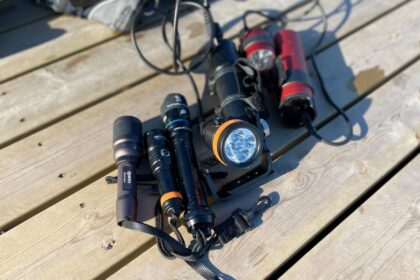























Dive lights vary widely in real-world performance, and not all models deliver the same brightness, beam quality, or reliability underwater. Differences in lumen output, beam angle, battery systems, and construction can significantly impact visibility on night dives, in low-visibility conditions, and in caves or overhead environments.
At DIVEIN, our team tested more than 15 dive lights across night dives, low-visibility conditions, and cave environments. Each light was evaluated using consistent criteria, including lumen output, burn time, beam quality, and the effectiveness of spot versus flood beams in different scenarios. Based on this hands-on testing, we selected the best dive lights for 2026 to help you choose the right option for your diving conditions.
Scubapro Nova 850

Where to buy
We compare prices daily across all major online stores.
See all 4 pricesScubapro Nova 850 Dive Light review
The Nova 850 is an amazing dive torch for any diver looking to have a reliable and versatile dive light. This relatively new product sports 850 lumens and is super easy to use. I love the sleek and lightweight design made from heavy-duty aluminum. Scubapro is one of the most well-known brands in the scuba diving industry and they make lots of different accessories for divers including BCD’s and Masks. The Scubapro Nova 850 is one of the best dive lights as it is built to last.
Orcatorch D630

Where to buy
We compare prices daily across all major online stores.
See all 4 pricesOrcatorch D630 Dive Light review
Hands down one of the best dive lights in the industry is the Orcatorch D630. With 5 hours of runtime at its brightest setting emitting a whopping 4000 lumens, the Orcatorch D630 does not disappoint. As soon as you pick this unit up, you get the impression of quality. This dive light is a favourite for cave divers as well as professional divers when surveying areas for work.
Mares EOS 20RZ

Where to buy
Mares EOS 20RZ Dive Light review
This Mares torch is one of the bulkier dive torches, however the light emitted offers a luminous intensity that is second only to the Tovatec Fusion 3600. With a whopping 2300 lumen output, if you’re looking for the brightest dive light… this is the one for you. This dive light is great for dive instructors and divemasters alike, who need a strong bright and wide light in order to illuminate the environment while leading dives.
Big Blue AL1200NP-II

Where to buy
We compare prices daily across all major online stores.
See all 4 pricesBig Blue AL1200NP-II Dive Light review
Big Blue is a brand known for producing high quality dive lights, their Big Blue AL12000NP-II model is a great device that many divers rely on for their night dives. This torch produces a soft but strong light and can last up to 20 hours on its lowest power setting. The battery life of this torch makes it an ideal back-up torch and as such I recommend pairing it with a wide range beam torch like the Mares torch EOS 20Rz.
Kraken NR 2000

Where to buy
Track this priceKraken NR 2000 Dive Light review
One of the best dive lights on the market for price, the Kraken NR 2000 offers seriously bright illumination and doesn’t compromise on range. This model of the Kraken dive lights is the favorite of wreck divers as it is compact and tough and is known to be very reliable. The Kraken NR 2000 is everything a recreational diver can ask for in a dive light.
Light and Motion GoBe 500 Spot

Light and Motion GoBe 500 Spot Dive Light review
For beginner divers looking for an all-round torch that can be used above ground as well as underwater, the GoBe 500 is the perfect instrument. With multiple mounting options and custom optics, the GoBee 500 is extremely versatile and is a good first dive light. If you’re a dive centre looking to buy a large quantity of standardized dive lights for training beginners and night dives, look no further. This reliable dive light is affordable and stylish.
Tovatec Fusion 3600

Tovatec Fusion 3600 Dive Light review
On this list is one of the most popular dive lights, the Tovatec Fusion 3600 is the brightest light on our top 10 best dive lights guide. Using a Cree LED light this dive torch can turn night into day and provides a focused beam to see some 200ft / 60m into the distance. Although this torch is heavy and bulky it provides a very strong quality light and for this reason it is popular with divers of all levels.
Dive Rite LX20

Where to buy
Track this priceDive Rite LX20 Dive Light review
The Dive Rite LX20 offers a constant current, meaning that the brightness of the light emitted stays consistent until the battery runs out. Mainly used by experienced divers as a primary dive torch with a glove mount, this compact dive light is perfect for tech divers and cave divers. The Dive Rite LX20 has earned its place on this list for its quality and reliability.
Orcatorch D550

Orcatorch D550 Dive Light review
Orcatorch is one of the most reliable brands for dive torches. This model of the Orcatorch is known for its long battery life and bright light that is emitted in the form of a strong narrow beam. This means longer bottom time and peace of mind when on a night dive. This torch is recommended for divers of any level who want a reliable torch by their side when exploring wrecks or caves. The reliability and quality of this product places it at the top of our top 10 best dive lights list
Underwater Kinetics Aqualite Pro S

Underwater Kinetics Aqualite Pro S Dive Light review
From Underwater Kinetics comes the Aqualite Pro S. This dive light is designed to work for underwater photography as it produces a soft light that allows you to capture creatures with your dive camera. This dive light works perfectly when paired with a GoPro and is often used by experienced divers to capture underwater videos and stills. Its ergonomic grip and light weight makes it easy to handle and maneuver.
Light Monkey 50W HID

Where to buy
Light Monkey 50W HID Dive Light review
The Light Monkey 50W HID is a very useful tool for cave dives, as it gives of a bright and consistent light perfect for tech divers. Light Monkey has designed the 50W HID to have an adjustable beam in order for divers to be able to select the width as well as the angle of the light beam. Using a 20 amp hour lithium battery pack, the 50W HID has a burn time of 4 hours. Additionally, the solid factory sealed canister protects the battery from flooding.
Diverite EX35

Where to buy
Diverite EX35 Dive Light review
Diverite continues to produce industry leading products, and the EX35 is no different. With 4300 lumens of output emitted from a Cree XHP35 HI bulb this product is state of the art. Coming in at just under 2kg, it is slightly heavier than most other canister dive lights but for good reason. At max power this dive light has a runtime of six hours.


What to look for when buying a Dive Light?
When looking to choose the best dive light, there are a number of key factors that should be taken into consideration. For example, what you will be using the dive light for (photography, leading dives or personal use) and the type of diving you will be participating in (night dives, wreck dives or cave dives). Therefore, the things to consider when buying the best dive light for you are:
Light Intensity is measured in lumens and is very important for things like underwater photography, where you don’t want a strong light. Normally you want to go with something with around 1500 to 2500 lumen of output.
Light Beam varies from wide beam to narrow, focused beams. Our recommendation is to go with a torch that has options for different beam widths, such as the Mares torch EOS 20RZ W/Lock.
Dive Light Battery can come in rechargeable and disposable battery models. I personally like the disposable battery models as rechargeable batteries eventually stop holding their charge. That said, if you have a power bank you can charge your torch between dives. Another important point to note is that the best dive lights have a constant circuit, meaning that the brightness of the light remains consistent and doesn’t falter.
Dimensions of the dive light can be important when it comes to the handling of the torch. A heavier and bulkier dive light might get in the way of your other accessories, so I always recommend going with a lightweight flashlight like the Orcatorch D550.
For more information on other essential scuba diving gear, check out our Best guide to Underwater Cameras, Dive Knives, and DSMB.

Frequently Asked Questions about the Dive Lights For Every Budget
The ideal lumen output depends on how and where you dive. For daytime recreational diving, 500 to 1,000 lumens is usually enough to restore color and improve visibility. For night diving or low-visibility conditions, 1,000 to 3,000 lumens is a better range. Technical divers and cave divers often use 3,000+ lumens for maximum penetration and signaling. Higher lumens increase brightness but also drain battery faster.
A primary dive light is your main light source, designed for extended use with high output and longer battery life. These are typically larger, brighter, and rechargeable. A backup dive light is smaller, simpler, and used as a safety redundancy in case your primary light fails. Most divers carry at least one backup, especially for night or overhead diving.
No, regular flashlights are not suitable for scuba diving. They are not designed to withstand pressure, are not properly sealed against water intrusion, and can fail quickly underwater. Dive lights are specifically built with waterproof seals, pressure resistance, and beam designs optimized for underwater visibility.
Battery life varies based on brightness settings and battery type. Most dive lights run between 1.5 to 4 hours on high power and longer on lower settings. Rechargeable lithium-ion batteries are common and offer consistent output, while disposable batteries are typically used in backup lights. Always check burn time ratings before diving.
Beam angle depends on your diving style. A narrow beam (8 to 15 degrees) is best for night diving, signaling, and penetrating murky water. A wide beam (60 to 120 degrees) is ideal for underwater photography and video because it provides even illumination. Many divers prefer adjustable or hybrid beams for versatility.
Dive lights are highly useful even during the day. Water absorbs colors quickly, especially reds and oranges, so a dive light helps restore natural color and improve contrast. They are also helpful for looking into crevices, under ledges, and inside wrecks.
Beginner divers should look for a simple, reliable dive light with around 800 to 1,500 lumens, a single-button interface, and good battery life. Compact, rechargeable lights are usually the best balance of performance and ease of use.
Yes, a dive light is essential for night diving. You should always carry one primary light and at least one backup. A bright, reliable beam is critical for navigation, communication, and safety in low-light conditions.
Most recreational dive lights are rated for depths of 100 to 150 feet (30 to 45 meters). Technical dive lights can exceed this. Always check the manufacturer’s depth rating to ensure it matches your diving limits.
Rinse your dive light with fresh water after every dive, especially around seals and switches. Dry it completely before opening to avoid water entering the battery compartment. Store it in a cool, dry place and remove batteries if you will not use it for an extended period. Regularly inspect O-rings and lubricate them as needed.
 Take a moment to look at this.


Yes, it’s changing fast. What’s good today, will be old and outdated tomorrow.
I bought the heavy video lights
Now your newer models are much lighter and large on lumens.
Hi Toni,
For a smaller, lightweight dive light with an adjustable beam, I definitely recommend the Diverite LX20 as it is lighter than the Mares EOS but more compact and the beam can be adjusted to suit your needs.
Hope this helps!
I’d like an adjustable beam, smaller, light dive light. Any suggestions?
Thanks for sharing this precious information with us this really helpful for me.