



















































The Touchpads That Decide a Swimming Finish
Michael Phelps needed 50.58 seconds to win the men’s 100 m butterfly at Beijing 2008. Milorad Čavić took 50.59. The Honolulu Advertiser’s report at the time records the Serbian protest and subsequent review of the timing and video.
At the end of each lane, a pressure-sensitive panel had recorded the finish. Those readings become official results used for federation records and broadcast coverage. Confirmed results also matter in online betting, where general sports rules can provide for a service provider to carry out verification when a dispute arises.
For swimmers, everything rests on that last touch and the equipment ready to record it.
Inside the Panel at the Pool Wall
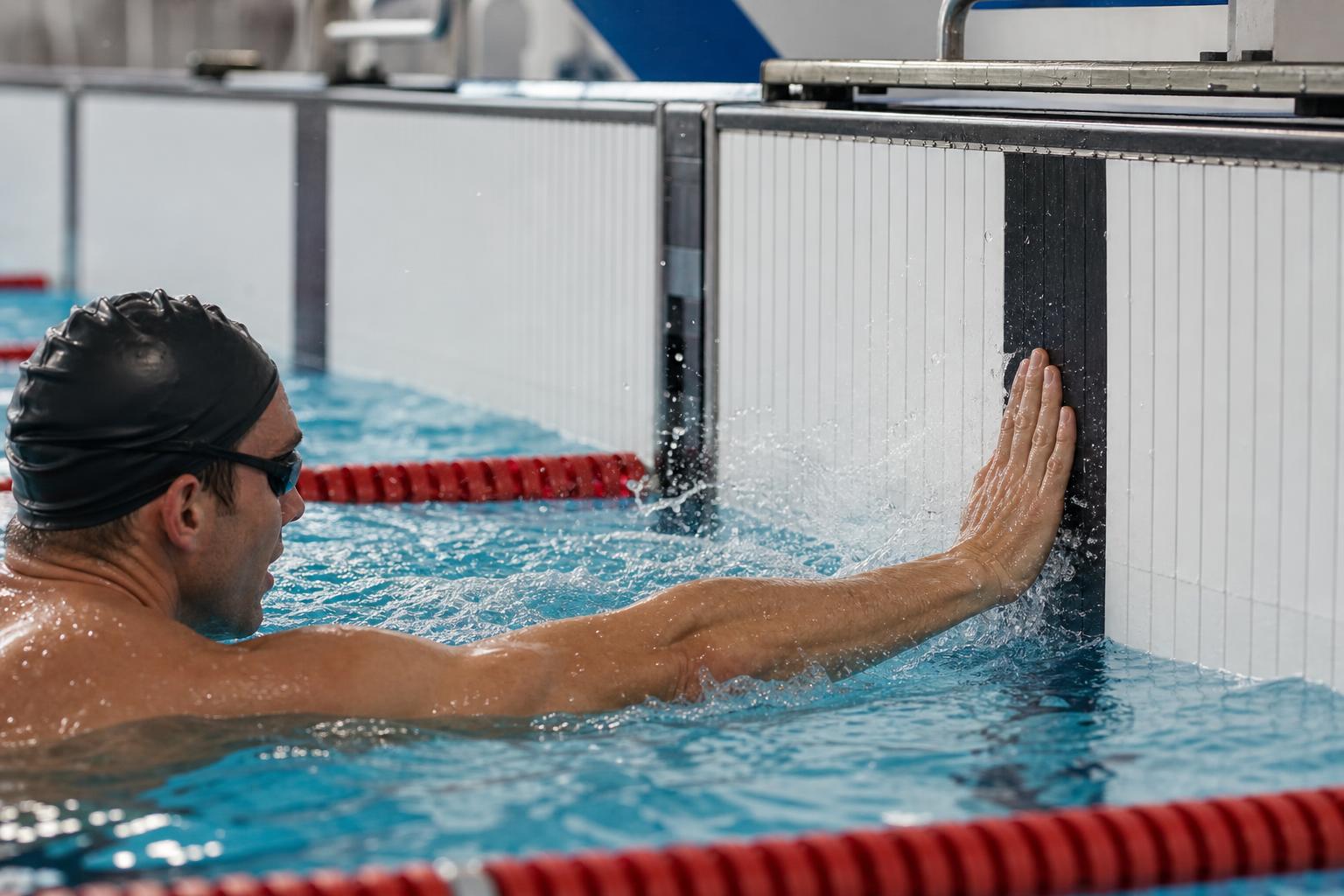
The touchpad covers the area where a swimmer reaches the wall. World Aquatics’ competition regulations specify panels at least 2.4 metres wide and 0.9 metres high, with 30 centimetres above the water and 60 centimetres below.
Each sits securely in the centre of its lane, with an independent electronic connection. Removable panels allow pool staff to take them out between competitions. The pool wall’s markings continue across their faces, with a 25-millimetre black border defining the edges.
Swiss Timing’s OCP5 manual describes interlinked PVC slats forming a slip-resistant surface supported by a stainless-steel frame. Behind them are electrical contact strips. Pressure on the slats closes those contacts and sends a signal to the timer. The manufacturer provides bracket and direct-mounting arrangements.
Enough Pressure to Register a Touch
With swimmers turning and finishing across several lanes, the panels operate amid waves and wash. They must respond to a light hand touch, including along the top edge.
The OCP5 manual gives an activation force equivalent to roughly 2 to 3 kilograms of weight applied locally. Its design responds to that concentrated push while accommodating broader pressure changes across the surface.
Before racing, technicians can test the response with a dynamometer, which measures force, and a buzzer that sounds when the contacts close. Checks include positions at water level and below it.
A soft touch can leave the contacts open even when a swimmer has reached the wall. Officials therefore need a backup reading taken independently of the panel.
How the Signal Becomes a Race Time
The timer records contact against its clock, and connected software links the timing information to the swimmer, lane and event.
In Swiss Timing’s Quantum system, incoming signals receive identifying codes. Intermediate touches supply split times, giving coaches and spectators a record of each swimmer’s progress. Operators can send results to scoreboards, print them or retrieve an earlier race for examination.
Primary and secondary timers can be synchronised to the same start pulse and receive the incoming timing information.
The software distinguishes between a finished race and an official result, allowing checks before confirmation.
What Happens When the Times Match?
USA Swimming’s timing rules require results recorded to hundredths of a second. Thousandths are discarded without rounding, and identical official times count as a tie.
World Aquatics likewise requires automatic times recorded to hundredths, the Olympic standard. The Canadian Olympic Committee records Simone Manuel and Penny Oleksiak sharing gold in the women’s 100 m freestyle at Rio 2016, both finishing in an Olympic-record 52.70 seconds.
Earlier generations raced under different rules. The International Swimming Hall of Fame documents Gunnar Larsson’s victory over Tim McKee in Munich’s 1972 men’s 400 m individual medley: 4:31.981 against 4:31.983, a difference of 0.002 seconds.
Checking a Finish When Every Hundredth Counts
Swiss Timing’s Quantum manual describes a 12-volt power pack for the timer interface. Adding battery-powered computers and an A4 printer allows competition operations to continue through a mains failure; connected displays require their own power arrangements.
World Aquatics’ 2026 regulations describe automatic touchpad timing as typically backed by video calibrated to a hundredth of a second. Officials can also operate push buttons to record finishes.
Under USA Swimming Article 102.23, a soft touch or conflicting finishing order can indicate a malfunction. Its comparison criterion is a difference of approximately 0.30 seconds or greater between primary and backup readings. After confirming a lane malfunction, officials calculate its valid backup time and combine it with accurate primary results.
Under those same rules, the middle of three differing valid button or watch readings applies. If two agree, that value is used. With two valid readings, officials average them and discard thousandths.
The Honolulu Advertiser reported that Beijing referee Ben Ekumbo confirmed matching times from the main and backup systems for Phelps and Čavić after the review. Gold remained with Phelps: a hundredth recorded at the wall and confirmed through review.