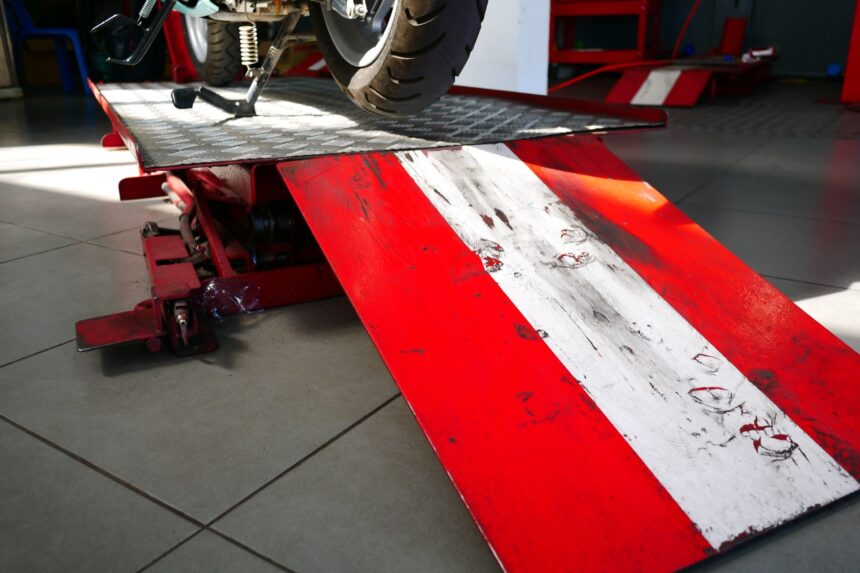
Australia’s winter season brings increased demand for motorcycle, ATV, and recreational vehicle maintenance as riders prepare equipment for changing weather and outdoor activities. In rural areas, farms, workshops, and private garages, efficient servicing solutions are important for keeping vehicles operational. A portable motorcycle and ATV scissor lift provides a practical method for raising small vehicles safely while improving access for inspection, repair, and routine maintenance.
Technical Overview of Scissor Lift Systems
A scissor lift works through a mechanical lifting structure that uses connected arms to raise a platform vertically. As the lifting mechanism expands, the platform moves upward while maintaining stability. This design allows technicians to access wheels, suspension components, brakes, and underbody areas without requiring permanent workshop equipment.
Portable motorcycle and ATV scissor lifts are commonly used for:
- Routine vehicle inspection and servicing
- Tire replacement and brake maintenance
- Cleaning and preparation before storage
- Workshop space management where fixed lifts are unavailable
Improving Efficiency, Safety, and Productivity
Vehicle maintenance performed at ground level often requires uncomfortable working positions, which can increase fatigue and reduce inspection accuracy. A properly designed lift improves working posture and provides better visibility of important components. For professional operators, this can shorten service procedures while maintaining safety standards.
For example, an agricultural equipment workshop servicing farm ATVs can use a portable lift to complete regular checks more efficiently without occupying space required for larger machinery.
Technical Fundamentals and Performance Considerations
The effectiveness of a motorcycle and ATV lift depends on several technical factors, including load distribution, platform stability, lifting range, and operating environment. The vehicle must be positioned correctly so that weight remains balanced throughout the lifting process.
Important performance considerations include:
- Compatibility with different vehicle sizes and designs
- Strength and stability of the lifting structure
- Quality of mechanical components and locking systems
- Regular inspection and maintenance procedures
Safety Practices and Equipment Selection
Safe operation requires more than selecting suitable equipment. Operators should place lifts on stable surfaces, secure vehicles correctly, and follow recommended operating procedures. Safety locks should always be engaged before maintenance work begins.
Different workshop environments may require different equipment types, including portable motorcycle lifts, ATV service lifts, hydraulic lifting platforms, and accessories such as side extensions or securing devices. Choosing the correct setup helps reduce risks and improves workflow.
Advantages and Limitations
Portable scissor lifts offer flexibility, space efficiency, and easier access for maintenance tasks. They are suitable for workshops, garages, and mobile service operations. However, they may not replace larger commercial lifting systems designed for frequent heavy-duty applications.
Future Trends in Vehicle Maintenance Equipment
As recreational vehicles and compact utility machines become more common in Australia, maintenance equipment is developing toward safer, more adaptable solutions. Portable lifting technology will continue to support efficient servicing by combining mobility, stability, and practical workshop integration.
Understanding the principles behind a portable motorcycle and ATV scissor lift helps equipment managers and operators make informed decisions about maintenance processes, workplace safety, and long-term equipment planning.
 Take a moment to look at this.