

















Any visit to the Campania region of Italy would hardly be complete without including the spectacular ruins of the ancient Roman cities of Pompeii and Herculaneum. Their popularity, however, does mean that they are often extremely crowded. If you’re looking for something completely different, cue the Monty Python reference, and a bit more off the beaten-track, I highly recommend a trip to the small marina town of Baiae.
Over the last couple of years, I’ve picked up snippets of information here-and-there about a large underwater archaeological site in the north of the Gulf of Naples that is accessible to the public. It turns out that modern day Baiae, on the Italian coast near the islands of Procida and Ischia, was the site of the Roman resort town of Baiae between 100 BC to 500 AD. Additionally, the first harbor base for Rome’s western naval fleet, the classis Misenensis, was established at Portus Julius just to the south of Baiae in 36 BC. Anyone who was anyone in Roman history during this period appears to have frequented Baiae. To give you a flavor; Julius Caesar and Emperor Claudius owned villas in Baiae. Emperor Nero not only owned a villa there but also had his mother murdered in hers, while Emperor Hadrian died of natural causes in his.
Submerged by the Sea
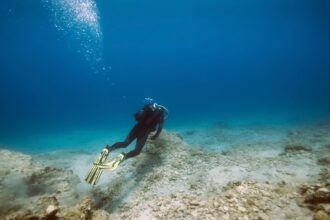
It is fair to say that Baiae has witnessed its share of human history, but it is the local geology that has turned it into such an interesting destination, especially for divers. The entire area, the Phlegraean Fields (Campi Flegrei), is situated on top of a collapsed caldera and subject to significant bradyseismic activity, experiencing uplift or subsidence as the magma chamber below fills and empties. For Baiae, this resulted in the lower part of the town and nearby Portus Julius being submerged by the sea. This was not an acute cataclysmic event like that which befell Pompeii and Herculaneum and it probably took many decades for the lower section of the town to become fully submerged. Nevertheless, the many original features of the holiday villas of Rome’s most rich and famous have been preserved just under the surface of the seabed in what is now Baia’s Archaeological Marine Park.
Let’s Dive In
SCUBA diving and snorkeling within the Archaeological Marine Park is restricted to authorized dive operators who schedule one hour time-slots on mooring buoys that mark specific dive sites within the park. We used Subaia Campania Divers, who are based in Baia, on the main road behind the marina where they keep their boat. They provide extensive briefings about the archaeological diving within the park in their office about an hour before their scheduled mooring time. Travel time from the marina to sites within the Archaeological Marine Park is minimal, but it can take 40 minutes or so to get to scenic sites outside the park (Procida and Ischia). They do not go to marine Park Punta Campanella, but can organise this through the Punta Campanella Diving Centre in Sorrento.
At a depth of only 5 m, Emperor Claudius’s Nymphaeum is arguably the most impressive site within the park. The identity of what must have been an extremely opulent villa has been inferred from the statue of Antonia Minor, mother to Emperor Claudius, in the ruins of what appears to have been a large nymphaeum. Rectangular in shape with a semi-circular apse, with at least one Lectus triclinaris buried in its centre and surrounded by statues of the emperor’s family, various representations of Dionysus and characters from Homer’s Odyssey; it is thought to have served a room for entertaining and fine dining. The original statues have been moved to a nearby museum and replaced with precise copies to avoid damage or theft following their discovery and excavation, but all other features of the site are original. These including; various foundations and walls, simple mosaics, luxurious marble and ceramic flooring, and sections of the Herculanea road that leads to Portus Julius.
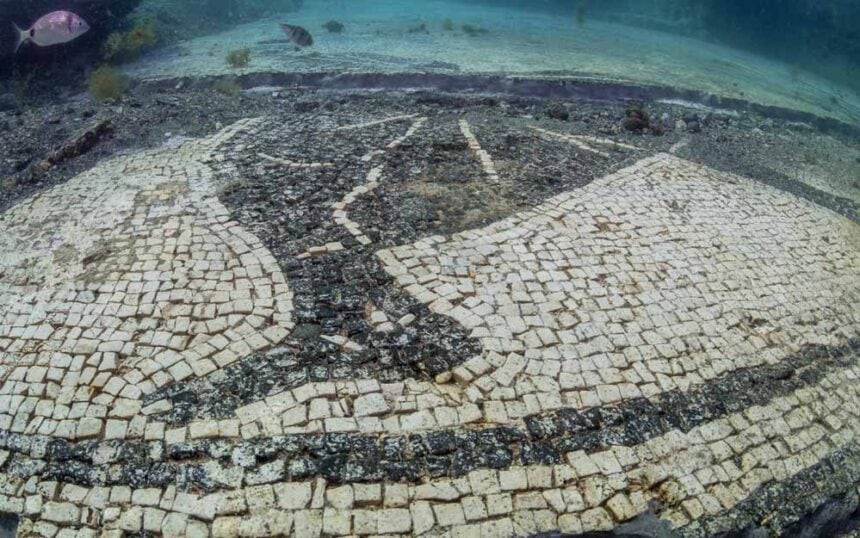
The origins of the ruins at the site referred to as the Prothyrum Villa are less clear, and it is named after the relatively intact prothyrum, or vestibule, at its entrance. However, this 5 m deep site is host to a number of outstanding and complex mosaics, with both geometric and pictorial themes. Archaeologists were working at this site during our trip, and it was extraordinary to see the newly uncovered details of figures in these mosaics firsthand.
Pisoni’s Villa is another site where a little more is known about the origin of the ruins. In this case, the discovery of a lead water pipe with the inscription of L. Piso indicates that the villa belonged to the Piso family. It has been proposed that Gaius Calpurnius Piso planned to assassinate Emperor Nero there, in what has since become known as the Pisonian conspiracy. This site is particularly shallow, at around 3 m, and includes remains of roman columns and walls, as well as several large areas of simple mosaic floor.
Lying at around 13 m, Fumose Reef is really only accessible to SCUBA divers. It takes its name from the active fumaroles that vent volcanic gases, heating the surrounding water and sustaining filamentous colonies of bacteria in and around the vents. This site also hosts the remains of enormous pillars, thought to have been part of the outer jetty of Portus Julius.
In addition to the Archaeological Marine Park, there is also a terrestrial archaeological park behind the main street of modern day Baia. In contrast to Pompeii and Herculaneum, you’re likely to find yourself almost alone as you wonder around this spectacular complex of thermal baths and temples. The Temple of Mercury is particularly noteworthy for it’s enormous 21.5 m diameter dome, that was the largest of its kind in the world prior to the construction of the Pantheon in Rome.
In Summary
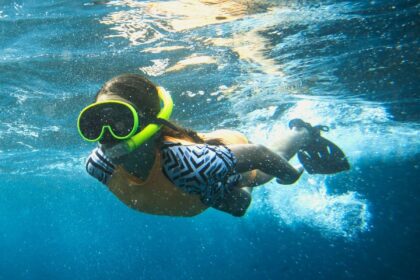
In summary, Baiae makes for an interesting and relaxed alternative to Pompeii and Herculaneum. While it is particularly attractive for SCUBA divers, much of the Archaeological Marine Park is shallow enough to be visible from the surface by snorkelers and the terrestrial archaeological park is also spectacular.
Author Bio
Jeremy Brown has a PhD in Immunology with considerable experience of microscopy and digital imaging. His interest in photography, diving and marine conservation have since led him to pursue a career outside biomedical research and he is now a self-employed photographer and remote image editor with Dreamstime LLC.
 Take a moment to look at this.