



































Promate Spectrum Prescription Dive Mask Review

DIVEIN tester Bradley in a drysuit and dive gear with his mask pushed down around his neck after a dive
By
Bradley Axmith
DIVEIN tester Bradley in a drysuit and dive gear with his mask pushed down around his neck after a dive
Senior Editor at DIVEIN.com
Bradley grew up feeling more at home in the national parks of Canada than in the city. Having an affinity for the seasons and a penchant...
- Senior Editor at DIVEIN.com
Our tester holding the wet Promate Spectrum prescription dive mask beside the water after a dive
A prescription mask only earns its place if the skirt and seal hold up as well as the optics do, which is why we judge the Spectrum on both rather than the lenses alone.
DIVEIN tester swimming at the surface in a black Promate Spectrum mask and blue snorkel
Surface swimming is where a snorkel mask is really judged, because that is where snorkelers spend their time and where a poor seal or a fogged lens ends the session early.
DIVEIN tester holding the wet Promate Spectrum mask by its strap buckle at the surface
Buckle hardware decides whether you can re-tension a mask with cold, wet hands, which is why we judge it at the surface right after a dive rather than dry on a bench.
Promate Spectrum mask held against the sunlit sea, showing the bonded lenses from inside
Held to the light the bonded lens gives almost nothing away, which is the point: it reads as a normal low profile dive mask rather than a piece of medical kit.
Close-up of the Promate Spectrum's bonded corrective lenses beaded with water
This close, the bond line and the lens markings are obvious. At arm's length in the water nobody notices, and neither will you once the view is finally sharp.
Our reviewer holding the wet Promate Spectrum by its strap to show the low profile skirt
A low profile skirt sits the lens closer to your eyes, which widens the field of view and keeps the corrective glass working where it is meant to.
Our tester holding up the Promate Spectrum mask by the sea, showing its two lenses
Two separate lenses are what make correction possible here: each side can carry its own strength, so divers with mismatched eyes are not stuck splitting the difference.

Where to buy

A low-profile scuba mask like the Promate Spectrum will make an excellent backup prescription dive mask. In fact, it’s proved itself so well, it’s good enough to be the primary.

Ordering this mask to match a nearsighted prescription was easy and the result—when tested out in the ocean both scuba and snorkeling—was surprising.

The bonded inserts matched very closely the teardrop lenses so it was hard to notice they were inserts. No distortion to complain about either. This is an all-around affordable prescription mask for a medium-sized face.

Just to note: we tested a mask with -1.0 and -1.0, which doesn’t demand thick inserts.

About this review

To help you find a Prescription Dive Mask that will fit your needs, we’ve tested, researched, and reviewed the best ones available today.
We test both in the water, diving in various conditions - and in our lab - so we can give you accurate answers on quality, performance, and the overall value.

Read about our test of Prescription Dive Masks

Recommended in: Prescription Dive Mask

Things we like:

  • Bonding is seamless
  • Soft, reliable silicone seal
  • Low-profile mask good for traveling or as a backup
  • Lens quality works without distortion

Things we don't like:

  • No half prescription lenses or bifocals

Better Than Contacts

Video
Promate Spectrum adult prescription dive mask worth

For anyone with myopia–near-sighted and using a minus prescription in glasses or contacts–the Promote Spectrum might be the best entry point for a prescription dive mask.

It’s going to be ideal for those with full or half magnification values (eg.: -2 or -2.5) as there are no quarters when ordering from the Get Wet Store. On the other hand, one of our testers uses a -1.25 in the right eye and didn’t have any reason to complain with just the -1.00.


Video
Promate Spectrum adult prescription dive mask snorkel

It’s a low-profile mask, which means the bonded lens sits closer to the eyes, limiting distortion. The bonded glass lens with the magnification seems the exact size of the two teardrop tempered glass pieces as well, hiding the fact that this is a prescription mask.
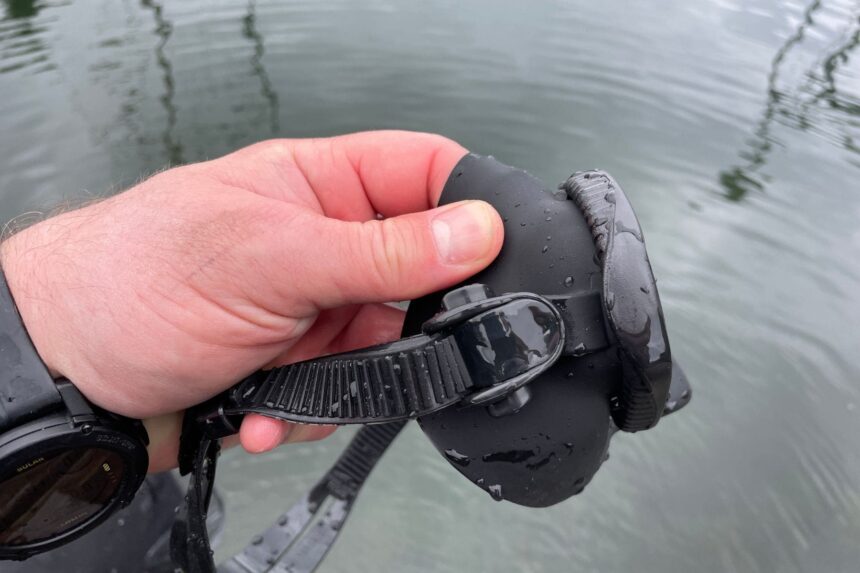

DIVEIN tester holding the wet Promate Spectrum mask by its strap buckle at the surface
Buckle hardware decides whether you can re-tension a mask with cold, wet hands, which is why we judge it at the surface right after a dive rather than dry on a bench.

Some toothpaste, used initially for defogging, might make it into the crevice between, but not much.

As far as the sizing goes, at 4½ inches wide by 3¼, this mask will fit most faces. The soft silicone skirt is also a bit forgiving on smaller faces too, but it’s not for bigger facial profiles.

The buckles on the silicone strap are equally forgiving, cutting down on hair pulling and providing a quick release when egressed.


Ordering a Mask with Prescription
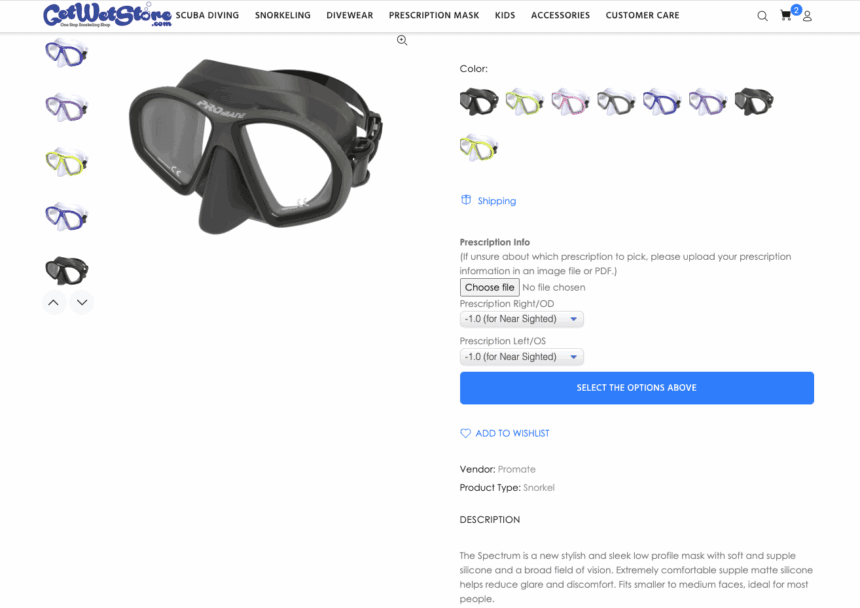
Online shop listing for the Promate Spectrum mask with colour and prescription strength options
You choose the strength for each eye at the point of order, so the mask that arrives is already yours. Getting that right on this screen matters more than anything you can adjust later.

When adding RX info—the prescription—there aren’t too many options on the product page. Choose a value for the right eye, add info for the left eye.
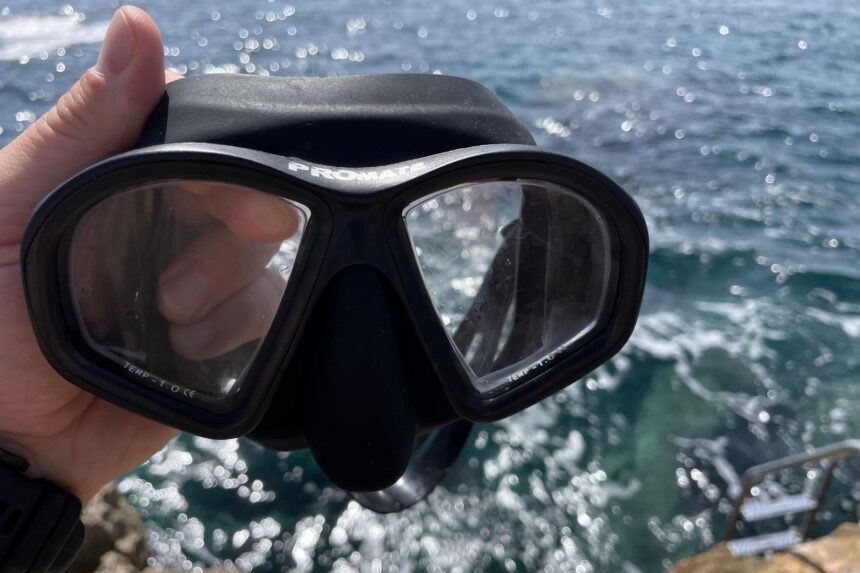

Our tester holding up the Promate Spectrum mask by the sea, showing its two lenses
Two separate lenses are what make correction possible here: each side can carry its own strength, so divers with mismatched eyes are not stuck splitting the difference.

Far-sighted, or hyperopic divers, should be a bit wary of adding an RX with too high a value. To put this another way, a pair of strong reading glasses aren’t great at helping focus when driving. Similarly, a +5.00 prescription in both eyes will help read gauges, but not in identifying fish beyond 5 feet away.


The Value of Sight
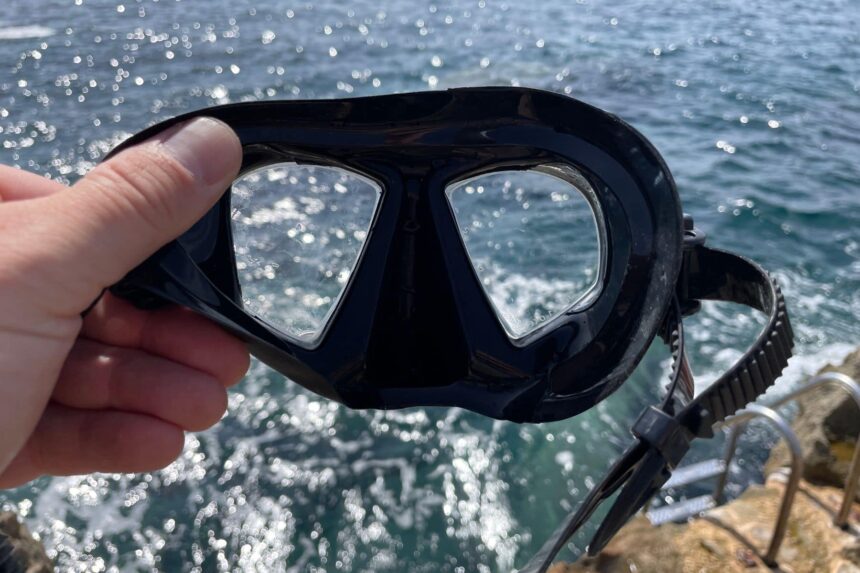
Promate Spectrum mask held against the sunlit sea, showing the bonded lenses from inside
Held to the light the bonded lens gives almost nothing away, which is the point: it reads as a normal low profile dive mask rather than a piece of medical kit.

A +1.00 in left and right eyes, on the other hand, will sharpen up the digits on your dive computer a bit without making it too difficult to focus further afield.

For astigmatisms or bifocals, a custom product is always going to be best. The Apeks VX1 from Prescription Dive Mask is very good at getting more complicated prescriptions installed. It’ll cost more, but we can attest to this mask being excellent optically.

We recommend this prescription dive mask for snorkelers and divers with less-complicated RX profiles. Simple spectacles, especially, will be easy to recreate.


But astigmatisms and/or any need for bifocals will require an alternative (and more expensive) mask and lens setup.

Additionally, myopic divers are going to be best served and more comfortable. Take note also that it is usual for divers older than 40 to have difficulty changing focus from near to far. There are bifocals in other masks we’ve reviewed that would be more appropriate for this demographic.

The surprising quality and comfort of the mask and lens setup for the 45-year old, near-sighted diver who tested these, however, is clear. For that, we can attest to the value of the Promate Spectrum prescription dive mask.

If there are any concerns about this, consult an ophthalmologist. Additionally, DAN has some info on related subjects for those curious.

Specs & Features

Nearsighted -1.00 to -10.00
Farsighted +1.00 to +4.50
Volume Low
Framed or Frameless Frameless
Bifocals No
Astigmatism No
Subscribe
Notify of
guest
0 Comments